

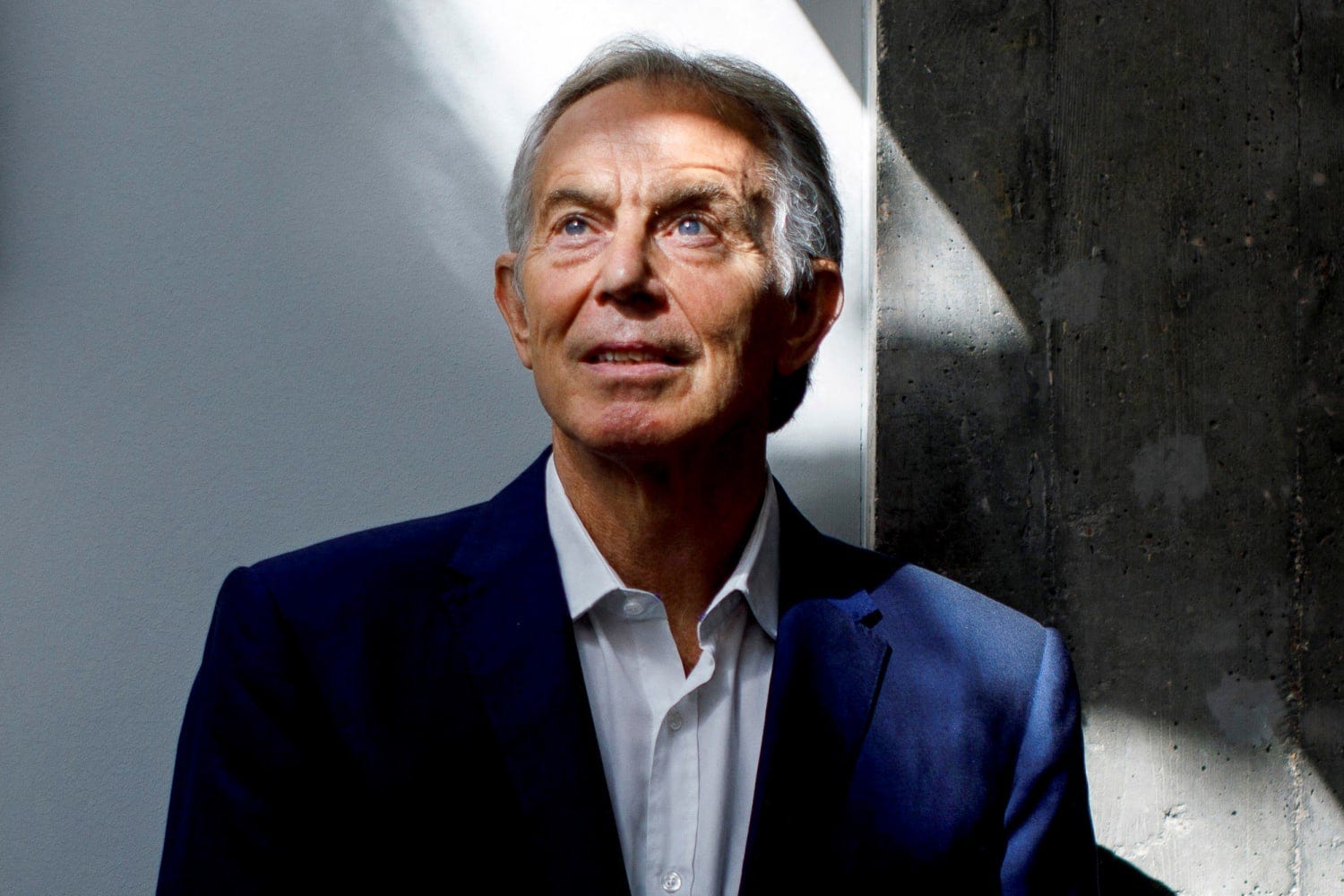
“He is an amazing politician. As a husband and as a human being, that's a different matter, but that's really between me and him.”
— Cheri Blair
I’ve just finished watching Channel 4’s three-part documentary The Tony Blair Story. Blair has always seemed so unremarkable as a person that I never took much of an interest in him, but I found this series surprisingly captivating despite Blair being as guarded and unapologetic for his reign as ever.
At the start of part one of the series, Blair is asked what impact his father having a stroke when Blair was only 11 years old had on him. Blair dismissively replies that he doesn’t engage in much psychoanalysis, but it “must have had an impact on my thinking about the world.” Towards the end of the series when pushed on his fateful decision to go to war in Iraq, Blair again repeats his view that psychoanalysis and introspection are overrated, and, much to the frustration of the interviewer, tells him “there’s no point carrying on trying to get me to see a different point of view from the one I had at the time.”
I think it’s this kind of refusal to engage with his legacy beyond repeating the spin-doctored policy justifications of the time that makes Blair such a reviled figure today outside the establishment. It’s not that Blair is defensive, it’s that he is completely averse to introspective moral scrutiny. George W. Bush’s reputation seems to have recovered better for his role in the ill-fated war on terror, because for all his belligerence and apparent idiocy, he was a man of instinct who acted on understandable impulses. Blair by contrast, is a technocrat who is always in the mode of justification, less concerned with whether the decision was right in hindsight than with preserving the coherence of the reasoning that led to it. I think most people rightly feel there is something unhuman about a refusal to introspect on a moral question of this magnitude.
But there is something even more unsettling about this persona of Blair, which is that his presentation as the archetypal late-modern amoral technocrat — concerned only with efficiency and spin — is paired with a very simplistic, totalising moral framework which motivated what turned out to be a radical political agenda.
The author Robert Harris, a former friend of Blair who now identifies him as a narcissist with a messiah complex, says in the documentary that Blair was motivated by a “Manichaean sense of good and evil” rooted in his Christian faith.
Yet Blair was the face of New Labour and “Third Way” politics, which marketed itself as a kind of post-ideological form of politics stripped of its old antagonisms and reduced to competent administration — if you want to understand this, read my essay The Triumph of Social Liberalism.
Blair dragged Labour out of exile and delivered them three successive national electoral victories by abandoning the old attachments of British leftism and embracing globalisation and markets. The party was unpopular due to its reputation for socialist mismanagement earned when last in government, so Blair simply abandoned any economic leftism that was unappealing to the British public, tore up decades of Labour conventions, and turned New Labour into a vehicle designed to win elections.
Of course, no politics is ever truly non-ideological. What Blair did was displace overt ideological conflict in domestic politics by bringing Labour into alignment with the emerging centrist, socially liberal consensus. Instead, the moral fervour of progressives was to be directed to the international stage. Blair grasped that after the Cold War, the central political divide was no longer left versus right or socialism versus free markets, but national versus post-national: between those who saw political legitimacy as rooted in the nation-state, and those who saw it as grounded in universal norms, transnational institutions, and individual rights. Blair was the first British Prime Minister to align himself decisively with the latter.
After all, all the most radical changes Blair brought are in this direction: the incorporation of the Human Rights Act 1998 bound British law more closely to the European Convention on Human Rights, something which now constrains successive governments’ ability to stop the inflow of illegal migrants on small boats; he expanded the role of courts and placed limits on parliamentary sovereignty in the name of universal rights; he massively expanded immigration in the name of competitiveness and openness, and in the words of his speech writer, to “rub the right’s nose in diversity”; he expanded speech restrictions and equality legislation to narrow the boundaries of permissible public discourse; and of course, he made Britain an active participant in a series of interventions — Yugoslavia, Sierra Leone, Afghanistan, and Iraq — that were justified not primarily in terms of national interest, but of humanitarian obligation.
Throughout all this, what motivated Blair? One factor is his Christianity, which was a much more important part of Blair’s worldview than one might imagine. Blair converted to Catholicism shortly after leaving office in 2007, but we are told by his old friends and colleagues that Christianity was important to Blair throughout his adulthood — his fellow University student and Anglican priest Peter Thomson is credited with both awakening his religious faith and his left-wing politics. At the start of episode 2, he says the film that most affected him was Schindler’s List, specifically the image of German cruelty over helpless captive Jews, and witnessing so many do nothing while this cruelty persisted.

Tony Blair is a Boomer, and like most of his generation, he has a rather simplistic moral worldview that is a fusion of a neutered, humanitarian Christianity and ‘Holocaustianity.’ The latter is a far more Manichean worldview where anything that would prevent the scenes Blair saw in the camp scenes in Schindler’s List is good, and any attitudes that could lead to it — or the kind of passivity that would allow it to happen in a distant land — are evil. This combined with Blair’s desire for adulation, to be seen as a liberator and a driver of progress, especially by destitute non-White people, is what drove his moral mission. We are told that the adulation he received on visiting Kosovo after Britain’s intervention there affected him deeply, the kind of adulation he then hoped for from the Iraqi people.
The apparent contradiction of Blair then — a technocrat on the surface and a crusading moralist underneath — is less of a contradiction when you understand it as a product of a specific historical moment in which those two tendencies could be fused. When the managerial, post-ideological mass democracies of the 1990s synthesised the socialist critique of capitalism, found a technocratic medium in economic management, and used the universal lessons of the 20th Century to direct Western elites’ moral energy to a more expansive and ideological vision of moral progress at the global level built on human rights universalism.
The problem for Blair is that the moral and political framework he operated within holds no resonance now. The assumptions that made his worldview plausible — the authority of the West, the universality of liberal norms, the moral clarity of intervention on the basis of invoking Hitler or Chamberlain — began to erode almost immediately after their high point. Iraq shattered the credibility of humanitarian intervention. The financial crisis undermined faith in technocratic governance. The catastrophic failures and unpopularity of mass immigration has shown the post-national project to be something forced on unwilling majorities by people with no moral mandate.
As an individual, Blair can seem especially reptilian compared to other politicians of his generation, but the same man was the most popular politician in his country in the 1990s because people found him relatable and “not like a politician.” Blair is really the purest expression of a moral and political order that has already collapsed. He now seems strangely out of time.
And yet, for all that, at the close of this series Blair boasts that his influence over British government is as great now as it was when he was Prime Minister. In January, another out of touch Boomer currently attempting his own ill-fated hubristic Middle-East adventure tapped the 72 year old Blair to head a Gaza ‘board of peace’ and oversee its construction.
The world that made Blair may have passed, but the system he helped build remains intact.
excellent. He reminds me of a bit of Woodrow Wilson. the same Social Gospel gnostic militancy and the addiction to process - Wilson was enamored of managerialism, a precursor
Tony Blair can be seen as a visible George Soros -- a person who believes in post-national, managed globalism, but who, unlike Soros, enjoys the limelight. He doesn't share Soros' non-belief in God, but is a crusader for a soft capitalism and mass immigration.