

The theory that Ashkenazi Jews descend primarily from converts in the medieval Khazar Khaganate, a Turkic polity in the Caucasus region, has been around for over a century. Though it was largely seen as put to bed by modern genetic science, this theory has recently taken on renewed popularity, driven by the rise in anti-Zionist sentiment since October 7.
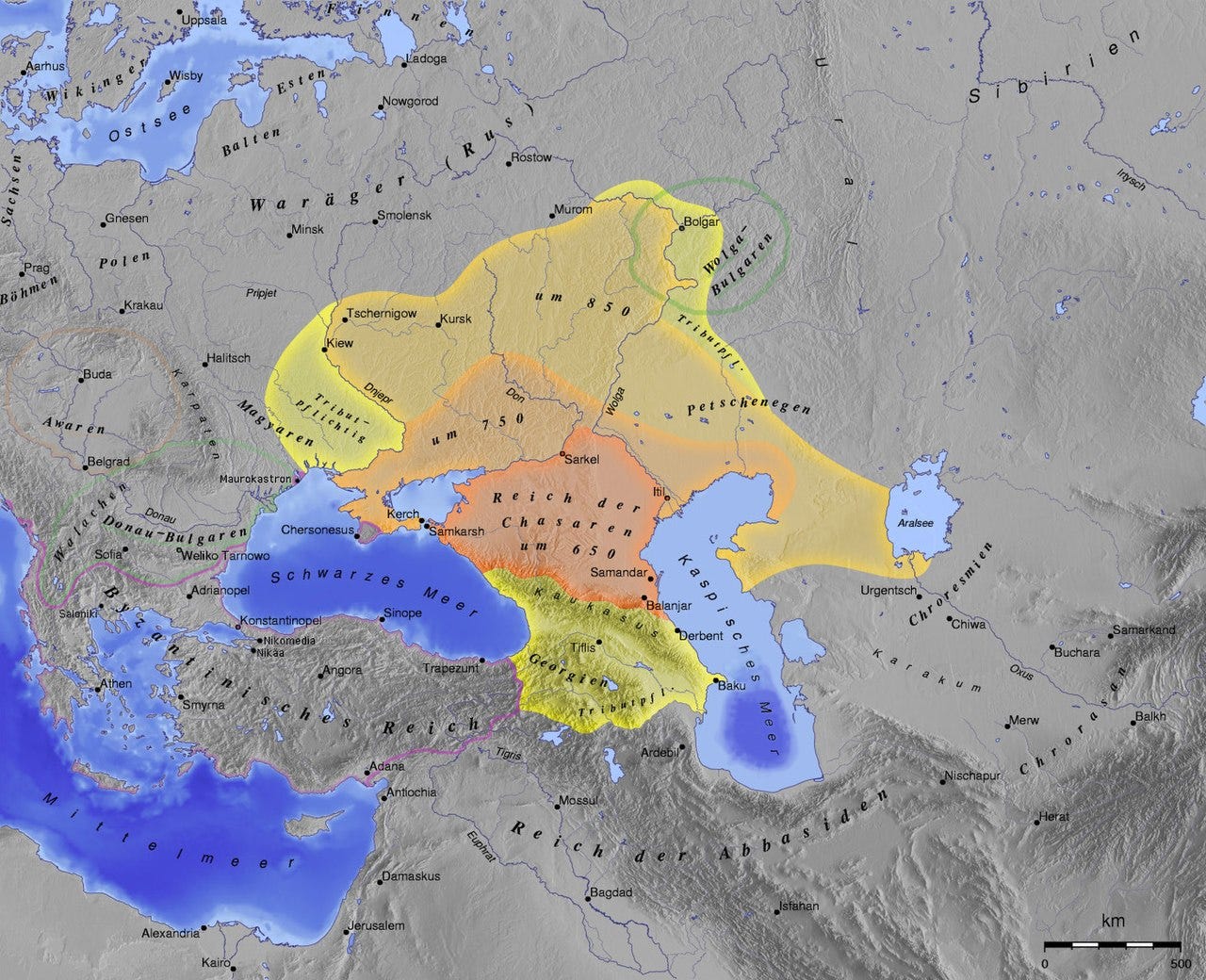
This belief has enduring appeal among anti-Zionists because, if true, it undermines the Jewish claim to an ancient biblical connection to Israel, and many of its proponents also see it as a clever way to sidestep accusations of “anti-Semitism.” Severing the connection between biblical Israelites and modern Jews is also why the theory has been adopted by some Christian anti-Zionists — this appears to be the primary motivation of Candace Owens, now the most influential proponent of Khazar theory. Candace has argued that acceptance of Khazar theory “doesn’t even require literacy” because of how self-evident it is that ““God’s chosen people” don’t mass murder, steal, create systems of usury and rape children in occult ceremonies.”


While the theory is now kept alive by conspiratorial audiences online, its origins lie in a small body of historical scholarship on the medieval Khazar state. A key body of Hebrew source material was published by the Russian Academy in Leningrad in 1932. This was followed by Abraham Nahum Polak’s History of a Jewish Kingdom in Europe (1944), which portrayed Khazaria as a substantially Jewish polity and entertained the possibility of a demographic legacy in Eastern Europe, linking it to the collapse of the Khazar state and a subsequent mass migration following the Mongol invasions — in fact, the kingdom had collapsed several centuries before the Mongols appeared on the steppe, a fatal error for Polak’s theory.1 The theory entered wider public debate, and took on its more maximalist form as an explainer for Ashkenazi origins, several decades later with the publication of Arthur Koestler’s 1976 book The Thirteenth Tribe.
Koestler, a Hungarian Jew, moved through several ideological currents — including Zionism and communism — but ultimately became a staunch critic of ideological nationalism and ethnic politics. Koestler’s biographer documents that Koestler told a French biologist that he:
Was convinced that if he could prove that the bulk of Eastern European Jews (the ancestors of today's Ashkenazim) were descended from the Khazars, the racial basis for anti-Semitism would be removed and anti-Semitism itself could disappear.2
In the introduction to The Thirteenth Tribe, Koestler outlines what he views as the most profound consequences of his theory — a final undermining of the “cruel hoax” of anti-Semitism:
This was written before the full extent of the holocaust was known, but that does not alter the fact that the large majority of surviving Jews in the world is of Eastern European—and thus perhaps mainly of Khazar—origin. If so, this would mean that their ancestors came not from the Jordan but from the Volga, not from Canaan but from the Caucasus, once believed to be the cradle of the Aryan race; and that genetically they are more closely related to the Hun, Uigur and Magyar tribes than to the seed of Abraham, Isaac and Jacob. Should this turn out to be the case, then the term “anti-Semitism” would become void of meaning, based on a misapprehension shared by both the killers and their victims. The story of the Khazar Empire, as it slowly emerges from the past, begins to look like the most cruel hoax which history has ever perpetrated.3
Koestler’s argument is speculative. Without the aid of modern genetic science, he constructs his theory around a few facts from the historical record:
The ruling elite of the Khazar Khaganate converted to Judaism around the 8th century.
The Khazar state collapsed after attacks by the Kievan Rus in the 10th century.
Large Jewish populations appear in Eastern Europe in the late medieval period, especially in Poland, Lithuania, and Russia.
From this, Koestler suggests that there may have been a large migration of converted Khazars to Eastern Europe in this period, who now comprise the bulk of Ashkenazim.
Interest in the Khazar hypothesis resurfaced more recently with the publication of Shlomo Sand’s 2009 book The Invention of the Jewish People, a work Candace Owens often cites as something that woke her up to Khazar theory. Sand, like Koestler, is a leftist Jew and an ardent opponent of nationalism, who similarly views the Zionist project as harmful to Jews.
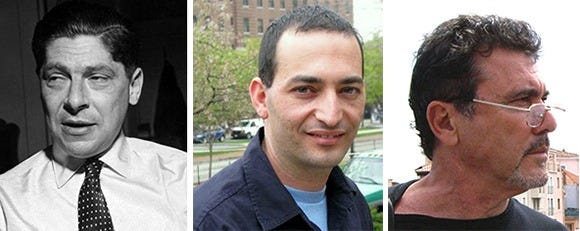
Sand rejects the idea of a unified, continuous Jewish ethnos descended from a biblical nation, as well as the traditional narrative of a mass exile after the destruction of the Second Temple. Instead, Sand suggests that Jewish populations outside the Levant emerged primarily through local conversions — most notably among the Khazars — rather than through diaspora communities maintaining biological continuity.
Though Sand’s theory addresses genetics, he seems unwilling to actually engage with genetic science, sometimes suggesting the whole enterprise is racist. For example, when geneticist Harry Ostrer announced the results of a DNA study revealing “a biological basis for Jewishness,” Sand responded that “Hitler would certainly have been very pleased.” Sand has also claimed that geneticists have avoided investigating the Khazar hypothesis because they know it would undermine the ancient foundation for a unified Jewish ethnic identity.
Setting aside genetics, there is little new in Sand’s historical argument, which is largely a repetition of Koestler’s in The Thirteenth Tribe. For additional historical evidence, he draws primarily on two sources — the highly dubious Cambridge document and King Joseph’s letter, which will be discussed in the next section.
Elsewhere, Sand writes that “the Khazars’ sacred tongue and written communication was Hebrew,” citing an Arab source named Ibn al-Nadim.4 In fact, al-Nadim merely recorded that Khazars used “Hebrew characters,” and this would have been limited to elites in what was otherwise a largely illiterate steppe society.
Sand also makes the claim that Hebrew characters entered the Cyrillic alphabet, through the Khazars’ early rule over the Russians. This suggestion finds no support among historical linguistics, or seemingly anywhere outside Sand’s work; the origins of the Cyrillic script are generally traced to Greek and Glagolitic forms developed by Byzantine missionaries.
Even overlooking errors like this, and setting aside the genetic record, Koestler and Sand’s broader theory is problematic from a historical perspective. The migration history of Ashkenazi Jews is relatively well documented and points to gradual migrations from Western and Southern Europe. After exile, Jewish communities existed throughout the Roman Empire and developed particularly strong roots in Italy during late antiquity. From there, they migrated northward into the Rhineland and northern France in the early medieval period, with historians documenting an established “Italy–Rhineland route of Jewish immigration.”5 One example is the Kalonymos family, a prominent rabbinic lineage documented to have moved from Lucca in Italy to Mainz, where its members became leading scholars in the emerging Ashkenazi community.6
These Ashkenazi communities later migrated eastward into Poland and Lithuania between the twelfth and fifteenth centuries. We know such movements were encouraged by Polish rulers who granted Jews legal protection and economic privileges, most notably in the Statute of Kalisz of 1264.
There is also no historical evidence for a mass westward migration of Khazar Jews. While remnants of Khazar populations likely survived in regions around the Caucasus after the collapse of the Khazar Khaganate, medieval sources do not describe any large-scale movement of Khazars into Eastern Europe. Contemporary chronicles do document the rise of Jewish communities in Poland and the German lands, but they make no reference to these migrants arriving from the Eurasian Steppe. If such a migration had occurred on the scale required by the Khazar hypothesis, there would surely be traces of it in the record: descriptions of migrating peoples in chronicles, references to Khazar or Turkic origins in Jewish communal traditions, or linguistic evidence of a Turkic substrate in Ashkenazi culture. Neither Koestler, Sand, or any other contemporary proponents of Khazar theory have produced anything compelling on this front.
What we do know is that the traditional language of Ashkenazi Jews, Yiddish, developed primarily from High German dialects with Hebrew and Slavic influences, reflecting its emergence among Jewish communities in medieval German-speaking Europe without any Turkic linguistic influence. Yiddish is primarily based on medieval High German,7 taking in elements of Hebrew and Slavic languages. The religious traditions and legal scholarship of Ashkenazi Judaism likewise show clear continuity with the rabbinic culture of Mediterranean and Western European Jewish communities rather than with the cultural milieu of the Khazar steppe.
Did the Khazars even convert?
Even the story of a large Khazar conversion rests on scant evidence. A 2013 paper titled Did the Khazars Convert to Judaism? has demonstrated serious problems with the sources commonly used to support the narrative of a large conversion among the Khazars.
The most commonly cited source is a letter from a Khazar king Joseph addressed to a Jewish scholar named Hasdai ibn Shaprut. Joseph’s letter, which describes the conversion of the Khazar ruling elite and the establishment of Jewish institutions in the kingdom, is written in “beautiful literary Hebrew,” with no reflections of a native Khazar language. The author of the letter also displays an apparent ignorance of the geography of the region. Despite the king describing his kingdom, he doesn’t mention any of the main cities, knows “remarkably little about its eastern part” or the groups populating it, or about trade routes or the commercial ties with other regions. The author seems to only be familiar with Crimea, about which he also makes apparent mistakes, leading historians who have analysed the document to suggest it was authored by someone who would have travelled from Constantinople to Crimea.
The Jewish king’s letter refers to great synagogues, study houses and other centers of learning containing renowned Jewish scholars throughout the land, yet:
None of the scholars are named, no other sources refer to grand synagogues or Jewish study halls, and no archaeological remains of Khazar synagogues have been found. In all of the rich literature produced in that time in the yeshivot of Jerusalem or Babylonia or preserved in the Cairo Geniza, there is not one reference to scholars in the Khazar lands, nor are there references to migration of scholars to Khazaria.8
The other powerful source for the Khazar conversion narrative is the so-called Cambridge Document or Schechter Letter, a medieval Hebrew text that purports to describe the conversion of the Khazar ruling elite to Judaism. The author of this document, and the date it was authored, is unknown, and none of the events in it have been corroborated by any other sources.
The events in the document read more like legend than real history, describing Khazar elites miraculously discovering preserved Hebrew books hidden in a cave. The Khazars who find these texts, despite growing up without books or any education in Hebrew education, were somehow immediately able to read and understand these complex Hebrew texts, sparking a mass-conversion. Hebrew scholars have identified many similarities between this story and the pseudepigraphic Jewish chronicle Josippon.
The document portrays Khazar society as having an established Jewish scholarly culture with institutions and traditions, yet this left no trace anywhere else in Jewish intellectual history. Stampfer notes that
In all of the rich literature produced in that time in the yeshivot of Jerusalem or Babylonia… there is not one reference to scholars in the Khazar lands.
The silence of external observers is equally significant. Byzantine, Muslim, and Rus’ writers described the Khazars extensively, often commenting on their political structures and religious diversity. These sources consistently portray the Khazar elite as religiously heterogeneous — sometimes mentioning Judaism among several faiths practiced within the khaganate — but none describe the large-scale Jewish kingdom or scholarly centers depicted in these Hebrew texts.
Also absent is archaeological evidence. If the ruling elite of a major Eurasian empire had adopted Judaism and established synagogues, academies, and a network of Jewish institutions, historians would also expect to find traces of this in the archaeological record. Yet despite excavations across the core regions of the Khazar Khaganate uncovering a wealth of settlements, fortifications, and burial sites, they have never revealed evidence of Jewish communal life on the scale described in the medieval narratives.
Archaeologists excavating in Khazar lands have found almost no artifacts or grave stones displaying distinctly Jewish symbols.9
A historical study of the burial practices of Khazarians note they retained pagan customs that would have been strictly forbidden in Judaism, such as trephination — boring into the skull’s cranial cavity — well after their alleged conversion.10
This is how an archaeologist of Khazaria summarises the archaeological picture:
There is very little archaeological evidence of the propagation of this faith among the population of the Khazar khağanate. Almost all of them are found in the large ancient cities on the shores of the sea, where the population was mixed, inhabited by people of different religious beliefs. But in the towns in the steppe and in the mountains, in the tombs, there are practically no Jewish artefacts. Their quantity does not allow us to think about the propagation of Judaism among the Khazars.11
The story of a Jewish Khazar kingdom is therefore far less certain than often assumed, resting on little more than a handful of noncontemporary and unreliable stories. But even if such a conversion did occur, it would still do nothing to support the claim that Khazar Jews migrated westward to form the basis of Ashkenazi Jewry. Modern genetic evidence provides a far clearer answer to that question.
New support for Khazar theory?
In 2013, an Israeli geneticist sensationally claimed to have proven the Khazar theory. Eran Elhaik’s The Missing Link of Jewish European Ancestry: Contrasting the Rhineland and the Khazarian Hypotheses argues that the genetic ancestry of Ashkenazi Jews is better explained by a Caucasus-centered origin than by the traditional model of migration from the Middle East through Western Europe. Using modern populations as proxies for ancient groups, he concluded that Ashkenazi Jews show closer genetic affinity to populations from the Caucasus region than to the Middle Eastern groups used in his model. Elhaik — who told interviewers he read Koestler’s The Thirteenth Tribe as a child — concludes that “our findings support the Khazarian Hypothesis and portray the European Jewish genome as a mosaic of Caucasus, European, and Semitic ancestries.”12
Given his background as a geneticist, Elhaik obviously cannot be dismissed as a kook. However, his proposal runs into many of the same problems discussed earlier for the Khazar hypothesis: there are no linguistic traces of Turkic influence in Ashkenazi culture, no evidence of a mass westward migration from the Eurasian steppe, no historical records among Ashkenazim describing such an origin, and no archaeological evidence of widespread Jewish communities in Khazaria.
There is another problem with Elhaik’s argument though, which is that a heterodox explanation like the Khazar theory is necessary because the massive growth in the Jewish population in Eastern Europe — from about 50,000 in the 15th century to around 8 million in the twentieth — could not be explained by natural population growth. He argues this is particularly true of a Jewish population “subjected to severe economic restrictions, slavery, assimilation, the Black Death and other plagues, forced and voluntary conversions, persecutions, kidnappings, rapes, exiles, wars, massacres, and pogroms.”13 Elhaik’s citations for this claim are Koestler’s The Thirteenth Tribe and Shlomo Sand’s The Invention of the Jewish people.
But there is really nothing remarkable about this kind of population growth, especially for an insulated religious group that combines high fertility rates and low rates of out-marriage. The Amish population in North America numbered only around 5,000 at the start of the twentieth century but has expanded to over 350,000 today. They are projected to reach 3–7 million by the end of the century, already matching the 20th century Jewish population in Eastern Europe from a smaller starting base. The Afrikaners in South Africa started from a group of only a few thousand Dutch settlers at the Cape in the seventeenth century, today it is roughly 3 million, largely through natural population growth.
Gershon Hundert, a historian of early-modern Jewry, has documented that Jews in Poland enjoyed both a higher birth rate and a lower mortality rate than their Polish neighbours, and also practiced earlier marriage, though he attributes most of the growth to low infant mortality.14 The Jews’ population growth was also remarked on by observers of the time, with Hundert quoting a Krakow university professor who wrote of the Jews “[n]one of them dies in war or of the plague. . . . Moreover, they marry when they are twelve . . . and so multiply rampantly.”15
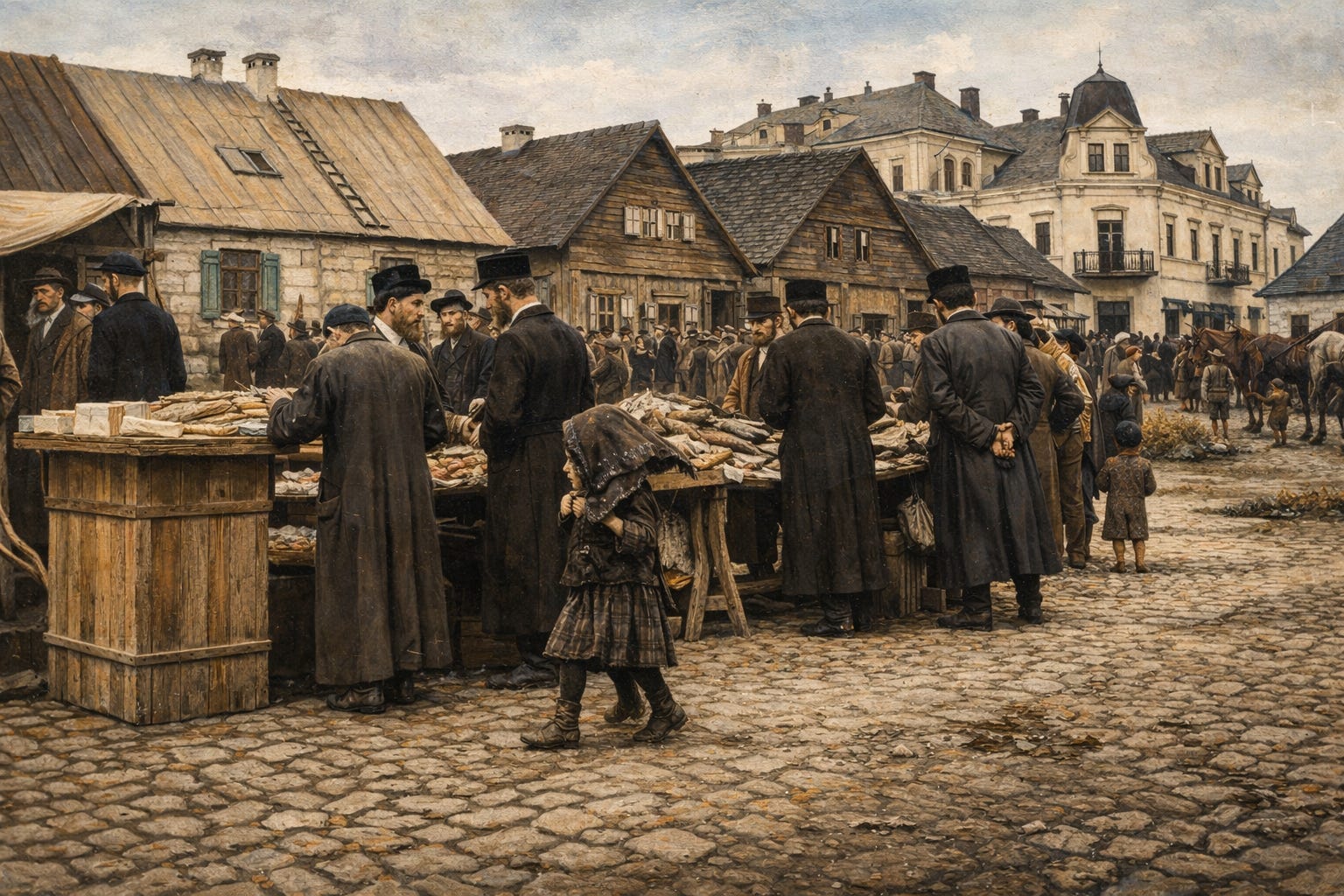
Elhaik is also vastly overstating the maltreatment Jews faced in this period. There is scant evidence of mass forced conversions or massacres of Jews, and modern historians now agree that Jewish life in the Polish–Lithuanian Commonwealth was relatively secure and autonomous compared to Western Europe. A papal diplomat, surveying Jewish areas of Poland in the 16th century, wrote:
They do not live here under pitiful conditions and do not engage in lowly pursuits… But rather, they possess land, engage in commerce, and devote themselves to study, especially medicine and astrology.... They possess considerable wealth and they are not only among the respectable citizens, but occasionally even dominate them.16
Similarly, Jewish historian Israel Bartal describes an economically powerful and integrated Jewish population, with large share of Jews working as artisans, merchants, and estate leaseholders, with many others managing regional and international trade:
At the end of the eighteenth century, nearly 30 percent of the Jews were linked to the estate lease economy, and managed means of production owned by the nobility: distilleries, breweries, flour mills, lumber mills, and the like.17
Far from being lowly, persecuted minorities, Jews by this time dominated the trades and made themselves key intermediaries between peasants and markets.
All this is to say that the historical anomaly Elhaik uses to support his Khazar thesis is not anomalous at all. But what of his genetic model?
Elhaik’s argument depends heavily on modelling ancestry using modern populations as proxies for ancient ones. In particular, he treats contemporary South Caucasus populations — especially Armenians and Georgians — as stand-ins for the Khazars, a medieval Turkic confederation whose genetic composition is largely unknown.
Elhaik writes that “Caucasus Georgians and Armenians were considered proto-Khazars because they are believed to have emerged from the same genetic cohort as the Khazars.” Here, Elhaik makes three citations, Polak 1951; Dvornik 1962; Brook 2006. The first two references are more than half a century old works on Jewish Khazaria that are now widely seen as outdated, the latter reference is to an “amateur Khazar enthusiast who has no first-hand knowledge of Central Asian studies.”18
Elhaik’s assumption here has been widely criticised by other geneticists, who point out that Armenians and Georgians are indigenous populations of the Caucasus with deep regional continuity and are not appropriate genetic substitutes for a medieval Turkic confederation whose ruling elite likely originated on the Eurasian steppe.
Elhaik himself refers to a study by Balanovsky et al., but fails to mention that it concludes that of all the national groups in the Black Sea region, the Georgians and Armenians were the least likely to have absorbed significant populations from other national groups. In other words, while there was DNA from eight Ashkenazi males in Elhaik’s study, there was no Khazar DNA at all. This makes it a bit difficult to come to significant conclusions about the Khazarian ancestry of Ashkenazi Jews.19
As a result, Elhaik’s model effectively tests whether Ashkenazi Jews share ancestry with Caucasus populations — not whether they descend from Khazars. But genetic similarities between eastern Mediterranean and Caucasus populations are already expected under the conventional historical model, since both regions were historically connected through migration and trade.
A second major criticism concerns the reference populations Elhaik used to represent Middle Eastern ancestry. A response paper with 20 co-authors criticised Elhaik’s methodology, noting that he used poor modern populations as stand-ins for ancient ones. Not only was his identification of Georgians and Armenians as a stand-in for Khazars misleading, but he chose poor proxies like modern Palestinians as proxies for ancient Judean populations. When alternative Middle Eastern reference populations are used, the genetic results change substantially.20
Taken together, these methodological problems mean that Elhaik’s argument for a Khazar origin is no more convincing than earlier historical versions of the theory. In contrast, the broader body of genetic research converges on a clear and internally consistent account of Ashkenazi ancestry.
The genetic picture
Across multiple independent genome-wide studies, Ashkenazi Jews consistently cluster between Levantine and southern European populations. They do not cluster with populations of the Caucasus or Eurasian steppe, as would be expected if they primarily descended from Khazar converts. This single finding is sufficient to rule out the Khazar hypothesis in its strong form.
More broadly, modern population genetics has established that Jewish communities across the diaspora share a significant component of Near Eastern ancestry traceable to the ancient Levant. Genome-wide analyses show that Ashkenazi, Sephardi, and Mizrahi Jews form related genetic clusters despite centuries of geographic separation, reflecting a common origin followed by varying degrees of admixture.
This pattern is also visible in uniparental markers. Paternal lineages (Y-DNA) tend to show strong continuity with Middle Eastern populations, while maternal lineages (mtDNA) more often reflect European origins — suggesting a pattern of outbreeding where Jewish men adopted European wives.
Early Y-chromosome research — which traces paternal lineages and shared male ancestry across populations — already pointed in this direction. A landmark 2000 study found that Jewish populations from Europe, North Africa, and the Middle East share a substantial set of paternal lineages derived from a common Middle Eastern ancestral population.21
The most influential genome-wide study on Jewish origins is a 2010 paper by Behar et al. Using hundreds of thousands of genetic markers, the researchers compared several Jewish populations with dozens of non-Jewish populations across Europe, the Middle East, and North Africa. The analysis showed that Jewish groups form closely related genetic clusters, reflecting shared ancestry despite centuries of geographic separation. Most Jewish populations clustered between Middle Eastern and southern European populations, indicating a substantial ancestral connection to the ancient Levant alongside varying degrees of admixture from surrounding host populations.22 Similar conclusions were reached in a parallel analysis of Jewish diaspora groups published the same year.23
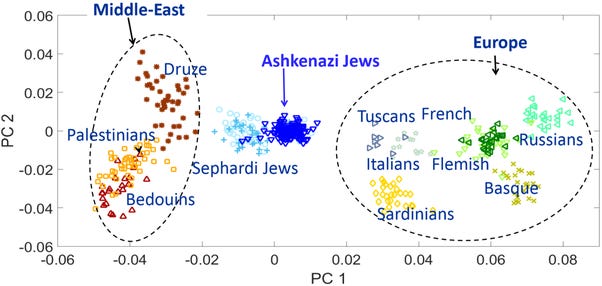
The origins of Ashkenazi Jews have attracted particular attention because the population emerged in medieval Europe while retaining clear genetic ties to the Near East. Research on the timing and location of European admixture suggests that much of this mixture occurred in the Mediterranean world. A key 2017 genetic study concluded that the European component of Ashkenazi ancestry most likely originated in southern Europe, with Italy highlighted as a plausible location.24
Ancient DNA research has further illuminated this picture. A major 2022 study of medieval Jewish remains from a cemetery in Germany confirmed a founder event leading to modern Ashkenazim, and supported a blend of Levantine and European ancestries, with subgroups showing varying proportions but overall continuity from ancient Jewish sources.
Genetic evidence also points to a demographic bottleneck in the medieval period. The Ashkenazi population appears to have descended from a relatively small ancestral group before expanding rapidly in Central and Eastern Europe, a process that helps explain the genetic homogeneity observed among modern Ashkenazi Jews. The Ashkenazi population appears to have descended from a relatively small ancestral group before expanding rapidly in Central and Eastern Europe.
Some recent analyses suggest that the European — particularly southern European — component of Ashkenazi ancestry may be larger than earlier models indicated. Several researchers argue that earlier genetic studies relied on imperfect reference populations when modelling “Italian ancestry,” typically including northern Italian groups such as proxies, even though southern Italians and Sicilians are genetically closer to eastern Mediterranean populations. Because northern Italians are more genetically similar to northern Europeans, these models may exaggerate the apparent genetic distance between Ashkenazi Jews and southern European populations.
Using stronger southern Italian reference populations, some recent studies estimate that Ashkenazi ancestry may derive largely from southern European — especially Italian — sources. One recent model estimated placed southern European ancestry at 68%, with most of the rest coming from Levantine and Middle-Eastern sources.25
Genetic historians have therefore proposed “a one-time event in the first or second centuries… when many Jews arrived in Italy and married locals before intermarriage sharply declined.” After centuries of relative isolation following this event, Jewish populations migrated to Northern and then Eastern Europe, with their genetics changing little since.
The picture we now have of Jewish genetics is impossible to reconcile with the Khazar hypothesis. While there is still room for debate over the precise balance between Levantine and southern European ancestry in Ashkenazi Jews, genetic studies consistently place them closer to Mediterranean and Middle Eastern populations than to peoples of the Caucasus.
More importantly, genetic studies show continuity in Ashkenazi ancestry across the medieval period. The genetic structure observed in medieval Jewish remains already closely resembles that of modern Ashkenazim, with no sign of the large-scale influx of Caucasus ancestry that would be expected if the population had been substantially reshaped by Khazar converts.
Taken together, the historical, linguistic, archaeological, and genetic evidence presents a consistent picture of Ashkenazi origins. Jewish communities developed in Europe through gradual migrations from the Mediterranean world, into the Rhineland and later into Eastern Europe. While conversion and local admixture occurred, as it does in all diaspora populations, there is neither the evidence for a large-scale migration of Khazar converts, nor a widespread conversion to Judaism among the Khazars.
And check out my new podcast:
Peter B. Golden, Khazar Studies: An Historico-Philological Inquiry into the Origins of the Khazars, 2 vols. (Budapest: Akadémiai Kiadó, 1980).
Michael Scammell, Koestler: The Literary and Political Odyssey of a Twentieth-Century Skeptic (New York: Random House, 2009), 546.
Arthur Koestler, The Thirteenth Tribe: The Khazar Empire and Its Heritage (New York: Random House, 1976). 1.
Shlomo Sand, The Invention of the Jewish People, trans. Yael Lotan (London and New York: Verso, 2009). 218.
Robert Chazan, European Jewry and the First Crusade (Berkeley: University of California Press, 1987), 21–22.
IBID, 22.
Max Weinreich, History of the Yiddish Language (Chicago: University of Chicago Press, 1980). 203.
Stampfer, Shaul. “Did the Khazars Convert to Judaism?” Jewish Social Studies 19, no. 3 (2013): 1–72. https://doi.org/10.2979/jewisocistud.19.3.1. 8.
IBID. 30.
Alex M. Feldman, The Monotheisation of Pontic-Caspian Eurasia: From the Eighth to the Thirteenth Century (Edinburgh: Edinburgh University Press, 2022). 53-54.
IBID. 54.
Eran Elhaik, “The Missing Link of Jewish European Ancestry: Contrasting the Rhineland and the Khazarian Hypotheses,” Genome Biology and Evolution 5, no. 1 (2013): 62.
IBID. 18.
Gershon David Hundert, Jews in Poland-Lithuania in the Eighteenth Century: A Genealogy of Modernity (Berkeley: University of California Press, 2004). 24.
IBID. 14.
Antonio Maria Gratiani, La Vie du cardinal Jean-François Commendon, trans. Fléchier (Paris, 1614), 190, quoted in Tadeusz Czacki, Rozprawa o Żydach i Karaitach (Kraków, 1860), 51, cited in Gershon David Hundert, Jews in Poland-Lithuania in the Eighteenth Century: A Genealogy of Modernity (Berkeley: University of California Press, 2004), 6.
Israel Bartal, The Jews of Eastern Europe, 1772–1881, trans. Chaya Naor (Philadelphia: University of Pennsylvania Press, 2005). 42.
Shaul Stampfer, “Are We All Khazars Now?” Jewish Review of Books, Spring 2014, https://jewishreviewofbooks.com/articles/802/are-we-all-khazars-now/
IBID.
Doron M. Behar et al., “No Evidence from Genome-Wide Data of a Khazar Origin for the Ashkenazi Jews,” Human Biology 85, no. 6 (2013): 859–900.
Michael F. Hammer et al., “Jewish and Middle Eastern Non-Jewish Populations Share a Common Pool of Y-Chromosome Biallelic Haplotypes,” Proceedings of the National Academy of Sciences 97, no. 12 (2000): 6769–6774, https://doi.org/10.1073/pnas.100115997
Doron M. Behar et al., “The Genome-Wide Structure of the Jewish People,” Nature 466, no. 7303 (2010): 238–242,
Gil Atzmon et al., “Abraham’s Children in the Genome Era: Major Jewish Diaspora Populations Comprise Distinct Genetic Clusters with Shared Middle Eastern Ancestry,” American Journal of Human Genetics 86, no. 6 (2010): 850–859, https://pmc.ncbi.nlm.nih.gov/articles/PMC3032072/.
Jingyao Xue et al., “The Time and Place of European Admixture in Ashkenazi Jewish History,” PLOS Genetics 13, no. 4 (2017), https://pmc.ncbi.nlm.nih.gov/articles/PMC5380316
Steven Parker, “How Ashkenazi Origins Were Mis-modeled: Southern Italian Ancestry, Proxy Bias, and the Illusion of Levantine Intermediacy,” Authorea, January 30, 2026,
Good piece. It's ironic how the Khazarian hypothesis is now used as a "politically correct" way to be an anti-Zionist because it does the opposite of challenging the idea of Jews as "the chosen people." I suppose Candace Owens would not have a choice but to support the Israeli project if she were convinced that its modern population is indeed descended from the ancient Israelites.
A nicely done takedown of a pernicious falsehood that has plagued the JQ space for years.