
British Elections: Boomers Win Again
The politics of the old still dominates electoral politics


Votes are being counted across Britain today for local elections that signal another defeat for the country’s traditional party duopoly and another step in the rise of Nigel Farage’s Reform UK.
These results seem to match what most were expecting, and I don’t know if there is much nationalists can take from this. Morgoth’s Review just published a good article discussing the election as a further sign of Britain’s move to sectarian politics and the end of traditional political alliances.
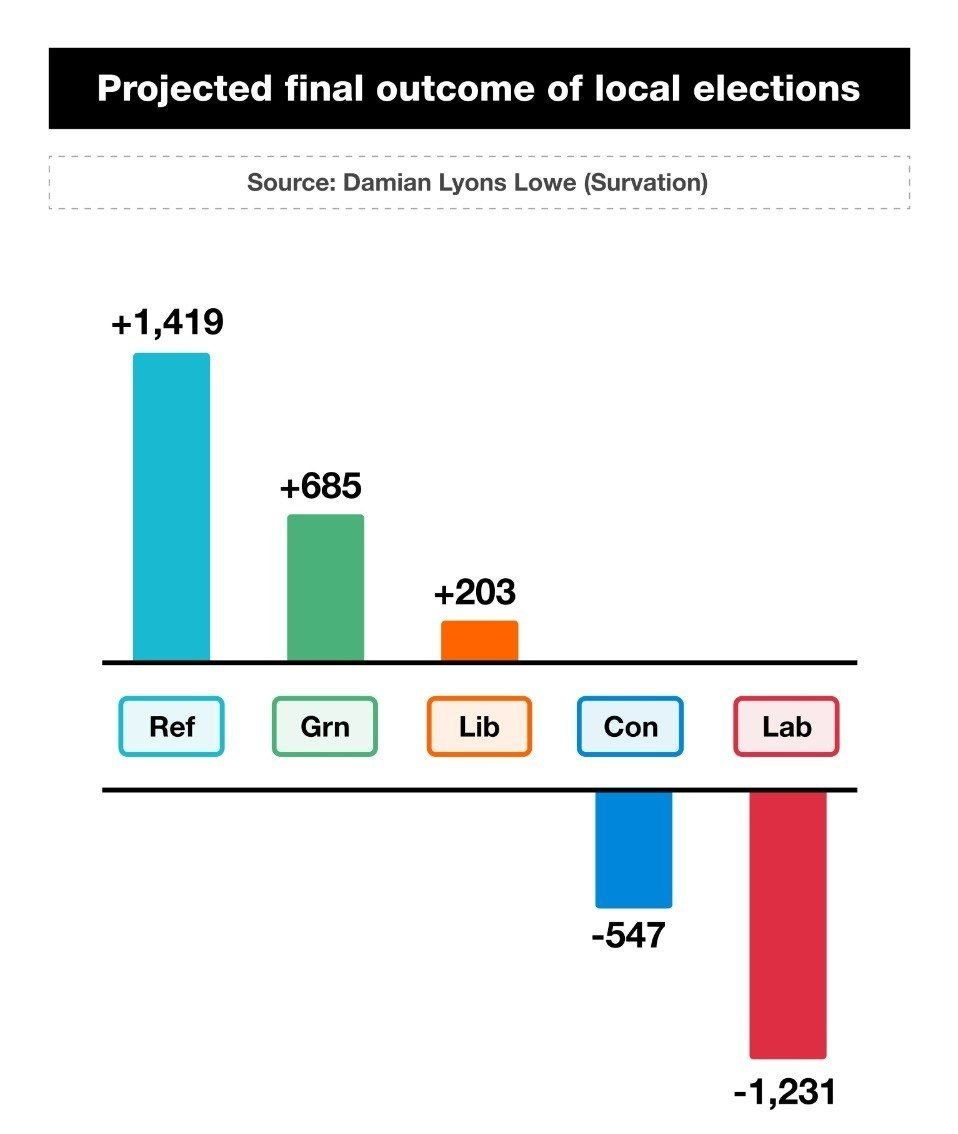
One group that definitely wins from this election is old people. Keir Starmer’s Labour government is historically unpopular for many reasons, but one of the most relevant to the greying British electorate is a debacle over winter fuel payments.
Winter fuel payments are one of the many universal benefits enjoyed by British pensioners — one in four of whom are millionaires. Despite its struggling finances, the British state gives all ten million of its pensioners a flat payment to spend on fuel.
When the British Treasury attempted to means test the payment and exclude the wealthiest retirees, the backlash was so severe that the government issued a humiliating U-turn. Doorstep canvassers, and a Labour minister, have reported this as the single most commonly cited grievance in 2025’s local elections and by-elections, and Reform — the favoured party of British Boomers — weaponised the issue with devastating effect.
Polling for the local elections in Britain consistently shows pensioners turning out at nearly twice the rate of under-35s. They also vote in far greater numbers for parties that protect their benefits. I’ve written before about how much the elderly vote also dominates Irish elections and props up the establishment parties. Ireland is bad, but Britain is one of the worst cases in the world of gerontocracy run amok. This was evident again recently when Tony Blair’s think tank suggested the state should scrap the so-called “triple lock,” which ensures pensions increase annually by whichever is highest: inflation, average earnings growth, or a flat rate of 2.5%.
The Office for Budget Responsibility estimates that state pension spending in Britain could rise by roughly £80 billion in today’s terms by the 2070s, with more than half of that increase driven by the triple lock. It’s hard to believe how irresponsible this policy is — the government is structurally committed to making sure pensioners gain more than the average worker, every year, even as the ratio of pensioners to workers reaches historically unprecedented levels and the birthrate craters.
Since 2010, the state pension for a Brit has climbed from £423 monthly to £1,048 – an increase of nearly 150%. During the same timeframe, average earnings have grown by just 66%, while 55% inflation has eroded most real-terms gains for working people.
Is there any other way working people would tolerate being screwed this badly? Of course, when Blair’s institute suggested reexamining this, there was a backlash from all the major parties, affirming their commitment to the triple lock.
Nigel Farage previously questioned the sustainability of the policy, but basic political incentives have forced an about-face. Recently, Farage promised to keep the funnel running by offering “the most radical proposals to cutting welfare ever seen in this country.”

Where might those savings come from? The state pension is already more than half the British state’s welfare bill. Perhaps reconsidering universal cash payments for retired millionaires, the generation that benefited immensely from property market timing and locked their children out of housing? No, Farage is also committed to fully reinstating the terms of the old universal fuel payment scheme that the loony lefty Labour government deemed fiscally unsustainable.
Of course, the problem of entrenched gerontocracy is everywhere in the developed world. French MPs approved France’s 2026 social-security budget only after the government agreed to suspend Macron’s pension reform, delaying the rise in the retirement age from 62 to 64 until after the next presidential election. In a country where over-65s now make up 22.2% of the population, this alone will blow a hole of up to €30 billion in France’s social-security finances.
It’s hard to fight gerontocracy, partly because of its ability to present itself as the unmarked condition of politics. Taking welfare from grandparents seems mean-spirited. The reality of how much policies like these are actually a direct transfer from poorer working-age people to often very wealthy retirees just doesn’t register with the average voter. Existing pension formulas, property privileges and healthcare priorities are treated as the natural order of things, while any attempt to change them is framed as an attack on the vulnerable.
But this is a trick of perspective. A policy that protects incumbent homeowners is no less “interventionist” than a policy that helps first-time buyers. A pension formula like Britain’s triple lock, which automatically ratchets upward, is no less a political choice than tax incentives for parents or public housing programmes. Gerontocracy wins by making its own privileges seem like the neutral order of things, and every challenge to them look like confiscation.
The conservative commentariat play a role in enforcing this. In The Telegraph, Andrew Orlowski shames moderns for considering something as anti-traditional as scrapping the triple lock:
In Confucian and Catholic cultures, where family ties are stronger and the elderly are revered, it would be unthinkable to hear such violent rhetoric against the aged.
Japanese legend preserved the story of ubasute, the carrying of an elderly parent to a mountain to die when the household could no longer sustain them. It does not appear to have been a common historical custom, but its existence as folklore is revealing. Traditional cultures did not imagine old age only through the sentimental modern category of entitlement.
The Confucian intergenerational compact was reciprocal: the young owed honour and support to the old, but the old were custodians of inheritance. They passed on trades, homes, land, tradition and a social order in which the young could prosper as adults. Defenders of the gerontocracy have scorn for the idea of this kind of obligation. They demand filial piety from a generation that has been priced out of becoming householders.
Given this settlement, is it any wonder young people’s self-reported well-being is now collapsing in the Anglophone world? Annual World Happiness Reports have shown a noticeable divergence emerging: while regions such as Eastern Europe and Latin America have seen reported happiness rise, English-speaking countries have moved sharply in the opposite direction.
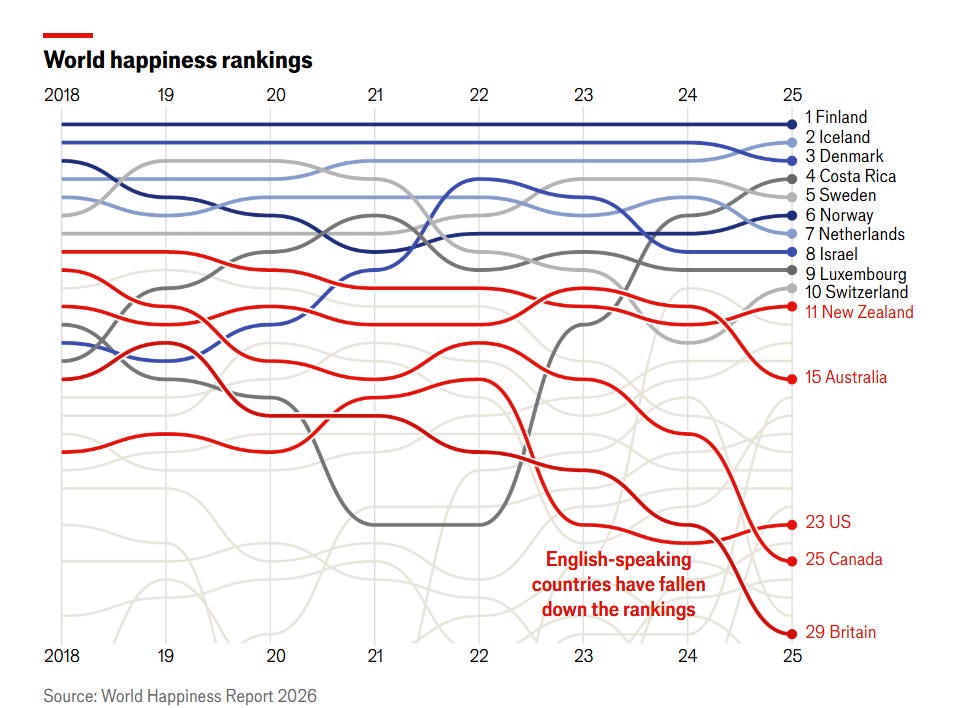
The Economist reports that this is being driven by the young:
The divergence is starkest among the young. In most other parts of the world young people are at least as satisfied with their lives as they were a decade ago, if not more so. But among under-25s in America, Australia, Britain, Canada, Ireland and New Zealand, scores have fallen—placing all six among the biggest declines for this age group.
Unsurprisingly, people have blamed social media, but it seems like South Americans and East Asians are just as hooked on their smartphones. But few places have a life cycle as broken as these countries. The young are expected to fund a system built around the security of the old while the basic milestones of adulthood recede further into the distance. Britain has one of the highest rates of millionaire emigration in the world, second only to China.
There is no sense of excitement about the future among the young in these countries. Lower paid jobs now have an added indignity as they have become dominated by cheap labour imported from the third world. Aspirational young people who aren’t emigrating are generally attempting some kind of hustle, scam or gamble to try and break out of their station. Social life has been privatised, with shared social spaces dominated by Boomers and young people priced out of everything. The consensus of the young in these countries, regardless of political orientation, is that things are destined to just keep getting more shit, and that is perfectly rational since it is the only trend they have observed as adults.
My latest book, Ethnopolitics, is now available. The book collects 15 of my best essays on how collective identity shapes the world. Its two lengthiest essays are exclusive to the book, a study of the psychology of the left and the mental pathologies that drive extreme leftism, and an ethnohistory of the Norman people and the extraordinary mark they left on European history.
“Keith Woods is one of the most accomplished of a rising generation of ethnic nationalists. His new book Ethnopolitics demonstrates its relevance to a wide range of political issues, showing why ethnopolitics is the wave of the future. I highly recommend Ethnopolitics to all my readers.”
— Greg Johnson
Purchase Ethnopolitics in your preferred format and region on Amazon:

> we need migrants to pay for pensions
> 5 million migrants arrive
> we can't afford pensions, welfare or just about anything
Bit ageist m8.
If money comes from old white pensioners and is given to young brown foreigners, I want the white folk to keep it.
Simple as.