

My latest book, Ethnopolitics, is now available. The book collects 15 of my best essays on how collective identity shapes the world. Its two lengthiest essays are exclusive to the book, a study of the psychology of the left and the mental pathologies that drive extreme leftism, and an ethnohistory of the Norman people and the extraordinary mark they left on European history.
“Keith Woods is one of the most accomplished of a rising generation of ethnic nationalists. His new book Ethnopolitics demonstrates its relevance to a wide range of political issues, showing why ethnopolitics is the wave of the future. I highly recommend Ethnopolitics to all my readers.”
— Greg Johnson
Purchase Ethnopolitics in your preferred format and region on Amazon:

There is a noticeable trend lately of influencers on the right being frustrated with the decline in quality of other influencers, and their own audiences. Things have become so bad that Alex Jones is regularly despairing at the lack of epistemological rigour among online conspiracy theorists now. With the election of Trump, the relaxation of censorship, the paranoia caused by the covid period, the growth of bro science and lifestyle twitter, and the rise of figures like Candace Owens, this is the age of the rightoid. To understand the direction of the right and the general downgrading of rightist discourse then, we must understand the rightoid and his motivations.
What is the rightoid? I don’t use it as a general insult for people on the right, but to describe a particular kind of low-resolution rightist: someone dispositionally destined to be anti-left, but not capable of serious right-wing thought. Rightoids are not low-IQ conservatives, though their thinking does overlap with low-IQ reasoning patterns. The rightoid is better understood through the core assumptions he uses to make sense of the world. I break these down into three similar but distinct filters through which the world is viewed:
Cabal theory
The fundamental tendency of the rightoid is to reduce all complex, impersonal systems to the intentional actions of a coherent, hostile elite. To be a rightoid is to anthropomorphise all social phenomena. This might sound a lot like defining “conspiracy theorist,” but conspiracy theorists may maintain a critical stance to the subjects they investigate or only conclude a conspiracy after investigating.
The rightoid does not treat cabal theory as something that must be argued for and defended, but takes it as a baseline assumption. Apparent anomalies or contradictions are not investigated in their own right, instead, they are treated as cues that something is being done behind the scenes — this is usually expressed in rhetorical they statements. In milder forms this resembles conspiracy thinking; in stronger forms it becomes an elastic and unfalsifiable theory of everything, capable of incorporating any contradictory evidence as further proof of concealed intent. QAnon is the extreme example. The funniest example of this kind of thinking is when rightoids treat the news cycle changing as itself proof of a nefarious conspiracy theory:
“First they told us to focus on covid, then they told us to focus on BLM, now they are talking about Ukraine. Get excited for next new thing!”
Aside from believing all social change comes through the agency of a cabal, the rightoid also believes the elites are motivated by evil. For Christians, this may take the form of believing the elites are satanists. For others, there is a belief that they are pedophiles or under the influence of some kind of occultic beliefs. It is from this theory that rightoids can make predictions about politics, and why their politics are so often wrong. For example, during covid it was common to see rightoids predict that the WEF would begin manufacturing food shortages, or implement climate lockdowns. Rightoids were unanimous that covid restrictions would never end because evil cabals do not willingly surrender power they have gained.
Epistemic populism
Rightoids reject mediated or expert knowledge in favour of intuition and in-group common sense. Institutional claims are not treated with skepticism because they are potentially contaminated by leftist bias, they are simply discounted on the basis of their source.
Rightoids have a frustrating character of being intensely skeptical yet showing little curiosity to investigate the things they are skeptical of. They may produce 100 reasons why humans could not exit the earth’s atmosphere that they have picked up online, but they will never have investigated any one of these with real scrutiny. Their skepticism is purely defensive: dissonant information is met with intense doubt, but the doubt never translates into real inquiry that could undermine their existing assumptions.

Romantic primitivism
For most people, their nominal beliefs are downstream of aesthetics and vibes. This is especially true for rightoids, given their anti-intellectual outlook. That vibe is romantic primitivism, an aesthetic and moral preference for what appears natural, traditional, or unprocessed. Modern, technical, or abstract systems are treated with suspicion, while the “natural” is granted an assumed authenticity. This brings the overlap with bro science and crunchy lifestyleism, with rightoids passionately opposed to things like pasteurised milk, sunscreen and the polio vaccine.
This is really what makes the rightoid dispositionally rightist rather than the type of left-leaning, hippie conspiracy theorists that used to smoke pot and watch Zeitgeist.
Although none of these alone explain the outlook of the rightoid, they are all manifestations of the same underlying orientation: a low-trust, intuition-dominant epistemic style that prefers agentic, morally legible, and experientially grounded explanations over abstract, system-level ones.
Why rightoids lose
Why does this mindset exist as a distinct type? I think it is basically a tribal mindset designed for close-knit societies. There is nothing really wrong with that. In fact, it is probably quite an adaptive mindset in a more natural setting. In the small-scale societies that were the norm for most of human history, the most important political facts were immediate and personal. Who is loyal? Who betrayed the group? Who is secretly coordinating against us? In that setting, this kind of threat detection and reliance on in-group knowledge was very adaptive. If more of our people had these instincts in a scenario where nationalists were in power, we would be better off for it.
The problem is that the right is not in power. For a political vanguard attempting to overturn the existing regime, this mindset becomes a problem. Modern mass society is a vast, technical system directed by complex bureaucracies, markets, legal regimes, media incentives, professional networks, ideological trends and demographic pressures. Trying to make sense of this in total is where this mindset becomes disabling. And if you cannot distinguish genuine conspiracy from these systemic forces, you become incapable of understanding or tackling any of them.
This puts the right at a serious disadvantage. Leftists are generally better at thinking in systems. The left understands pipelines, funding networks, legal pressure, bureaucratic capture, activist institutions, cultural production, personnel placement, and long-term cultural change. In other words, it thinks in terms of metapolitics. It has many political manifestations, but it is fundamentally the metapolitical project of White erasure and emancipation toward normative egalitarianism and liberal pluralist societies. It may be wrong about human nature, but this is not a political weakness while it understands institutional reproduction.
It also makes serious analysis difficult. This has two deleterious effects on the right. First, it makes it harder to attract intelligent, elite human capital who seek systemic explanations and want to deepen their understanding of social phenomena. Second, it makes it harder to organise against leftism, leading to a kind of paralysis where rightoids either wait for a saviour figure to dismantle the existing elite structure or place their faith in an eventual collapse or civil war scenario.
Social phenomena that require layered explanation are flattened into moral accusations. Think of how many conservative commentators explain things like modern art and architecture as consciously designed to make you hate yourself. Of course, this kind of thing can be useful for propaganda purposes, but as maxims like this have come to dominate the online ecosystem, most now operate on nothing but their own propaganda. There is real hostile intent from our elites, but because hostile intent is a default master explanation, the right cannot properly rank causes. Everything becomes equally intentional, equally malicious, and equally urgent, and this destroys strategic discrimination.
Why is there no leftoid problem?
The left has leftoids just like the right has rightoids. If we take a rightoid to be the middling IQ pseudo-normie who has a tribalistic bent to right wing politics, then the leftist equivalent is the status-anxious moral conformist. Leftism among intellectuals is built out of elaborate abstractions, but it is enforced by masses of progressives who barely understand these ideas. The apparent system-thinking of the average leftist is just fluency with institutional language. A leftoid will look at any political issue and point to some kind of systemic injustice like “capitalism,” “patriarchy,” or “White supremacy” as its cause. This is the left-wing equivalent of the rightoid’s “they.” For the rightoid, the cognitive plug is “they planned it,” for the leftoid, the cognitive plug is systemic oppression. Both are monocausal reductions of social phenomena that bypass real analysis, but one is rooted in distrust and disagreeableness and one is rooted in conformity and status anxiety.
But the left is not constrained by its leftoids in the way the right is with its rightoids because the leftoid’s instincts are compatible with the institutional form of left-wing politics. Regardless of how hysterical, shallow or stupid the leftoid is, they likely remain plugged into a leftist institutional machine led by capable organisers. Any issues they may have with their own party or activists is secondary to tackling the larger problem of the right wing. A leftoid can be told: donate to this organisation, attend this protest, report this enemy, vote for this candidate, share this campaign, defer to this approved expert. He may do all of this for stupid reasons, but he will still do it. He is socially programmable in a way that benefits his side.
In contrast, the rightoid will find reasons to avoid this rooted in suspicion. Either they will have given up on politics or they will treat any right wing politics presented to them as a likely op or grift. Imagine how much easier the task of the right would be if there were a large portion of progressives who:
Encouraged their own side to give up on activism and take up farming instead
Encouraged stochastic violence
Constantly badjacketed their own leaders
Accused all fundraising efforts and organisations of being a grift
Rejected their intellectuals for endlessly talking and not “doing something”
This contrast in attitudes is why you get a map of political attitudes that looks like this:
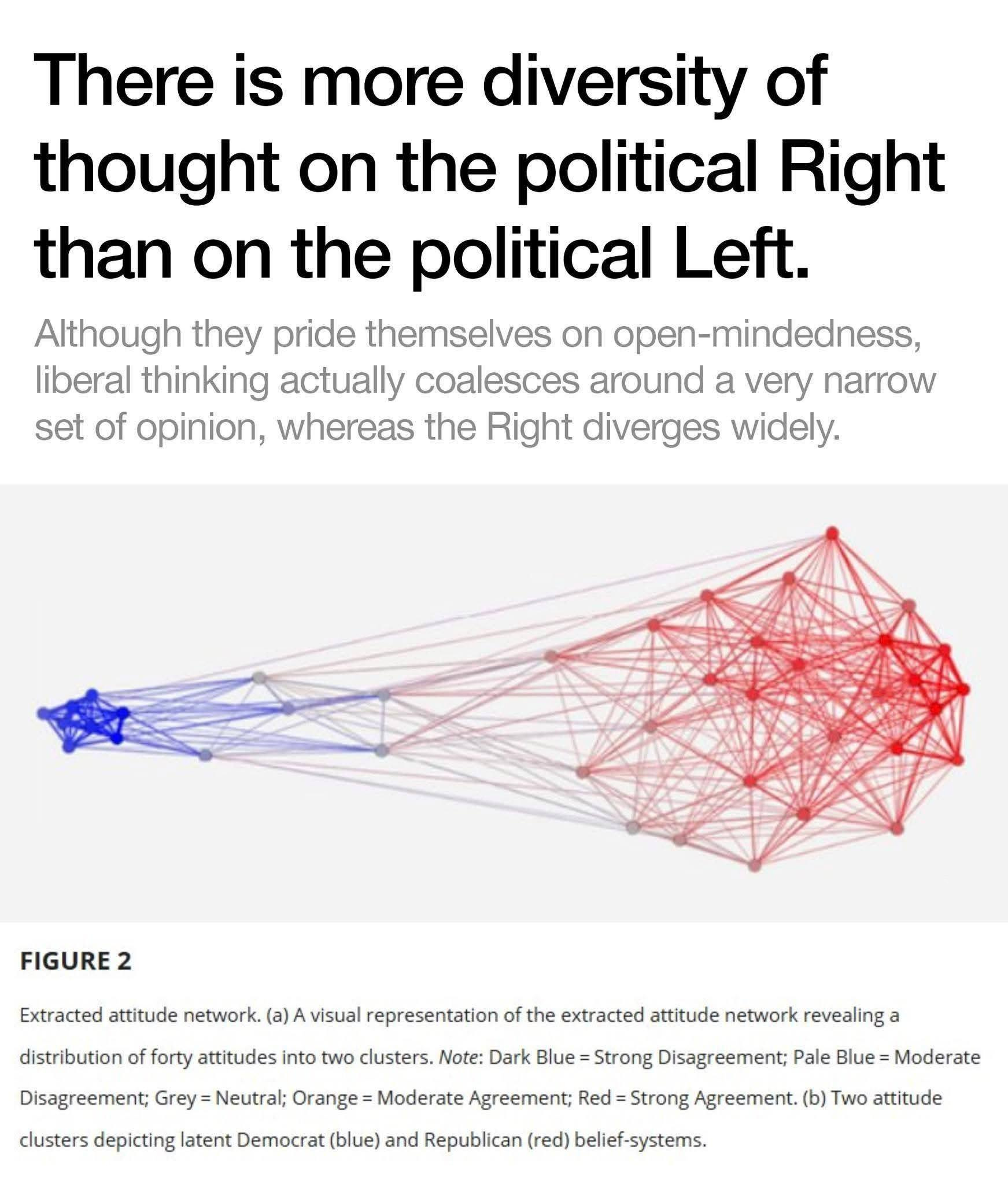
When this was published, a lot of conservatives were sharing it as a source of pride, but this kind of unity is obviously a huge source of strength for the left.
The conclusions to be drawn from this are quite bleak. Nationalists that want to build a competing political movement not beholden to rightoids will have to do things to attract people who are not natural cranks, but with influencers competing for audiences there is always a strong incentive to play to the larger rightoid demographic.
Without principled thought leaders who can support themselves independently of the crowd, there’s always a strong incentive to go along with these trends. But being a public influencer on the right with any pull is itself something that selects for amoral showman types willing to chase algorithmic trends for money and clout.
There is no easy solution to this. But it is clear that a serious nationalist movement will have to present a really differentiated alternative and build institutions, political organisations and thinkers not entirely dependent on the same social media incentives. We can hope there are enough like-minded people who have quietly watched these trends and come to similar conclusions are waiting for that serious movement to get behind.
A few words in defense of "rightoids":
Many of these people Keith dismissively refers to as "rightoids" correctly smell a rat but haven't done the work of tracing the rat to its nest. They are not "natural cranks" but people who know something is wrong but don't understand precisely what. So they latch onto simplistic or false explanations in lieu of accurate ones.
The proper response to such people is to provide a more adequate explanation, not ridicule and dismiss them out of hand. Don't tell them "Move on, nothing to see here" the way establishment media and experts do; say instead something along the lines of "You are not entirely wrong but what really happened here is ______, not _______ as you suppose." [fill in the blanks as appropriate]
The "rightoids" are not wrong in attributing many contemporary and historical nefarious doings to an unspecified "they." In many such instances, there will indeed be a small, influential minority of the population responsible for the events in question. But anyone using the term "they" owes us an explanation of who "they" are. The problem is that this question does not usually have a simple answer. When they become more specific, "rightoids" will offer simplistic answers like "the Rothschilds." They are mistaken here, not in realizing that there are Rothschilds who are indeed up to no good, but in giving far too much weight to the role of the Rothschild family when there are far, far more elites shaping events than just the Rothschilds.
Rather than bemoan the "rightoids," at least be glad that they are no longer mainstream conservatives blindly trusting the authorities of the current system. Anyone who implicitly trusts today's authorities is a credulous fool.
Rather than wasting time creating psychological typologies to pigeon hole potential supporters of nationalist movements in, more useful intellectual exercises for nationalist thinkers to engage in would be providing more adequate analyses of power (e.g. using social network theory), cogent economic analyses, and most usefully of all, outlines of the social, political and economic policies which a future nationalist government might institute.
I have a friend like this. It stopped being worth talking because she would just say oh that never happened or that was staged. She is kinda like a seer. Which gets old.