

Spain has just carried out one of the most far-reaching migration moves in its modern history: the mass legalisation by government decree of hundreds of thousands — likely close to a million — illegal immigrants in the country. The measure was not included in a party manifesto or general election promise that the Spanish voted for. Instead, in what is now a familiar pattern in European politics, it was declared through executive fiat after years of pressure from left-wing NGOs and minority coalition partners.
This episode is tragic — Spain is truly one of the most beautiful countries in Europe with an extraordinary historical inheritance. What is doubly tragic is the bizarre coalition that produced it: a convergence between radical feminist and migrant activist networks on one side — a group with contempt for historical Spain, and the institutional authority of the Catholic Church on the other — an institution woven into Spain’s national identity for centuries.
The public face of the push was Regularización Ya, a migrant-led initiative that forced the issue into parliament by collecting more than 700,000 signatures — well above the legal threshold for a citizen-driven legislative proposal. The movement first emerged in 2020, when COVID lockdowns caused anger among illegal immigrants who could no longer access work or welfare.
Their first protest happened in June 2020, in the Summer of Floyd. With African migrants highly represented among the organisers, a White guilt narrative about “modern-day colonialism” was front and centre from the beginning, with sympathetic articles writing about how the movement aimed to
Raise awareness of how institutional discrimination and the modern-day colonialism of Africa is deliberately being used to prop up the EU’s economy.
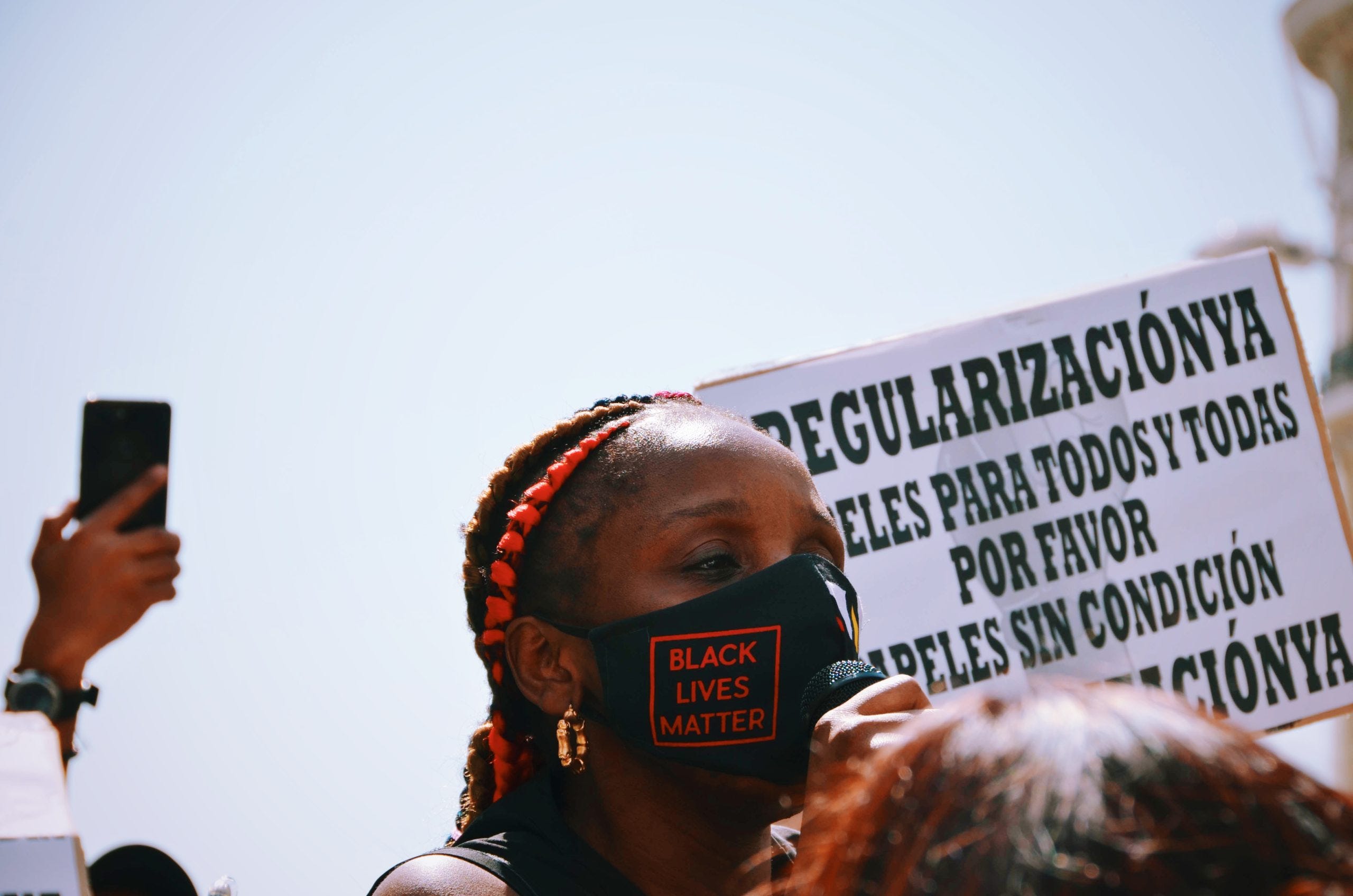
While Regularización Ya was loosely organised and seemingly lacked formal early funding streams, it soon built alliances with established NGOs and human rights groups, who would unite behind the movement as the spearhead needed to bring their agenda to the foreground of Spanish politics. And as the movement became more organised, an unmissable pattern is its lead organisers have overwhelmingly been leftist women.
Victoria Columba, an Argentinian who migrated to Spain in 2002, is the most prominent spokesperson for the group. She tells the media “We immigrants are here to change the rules of the game.”
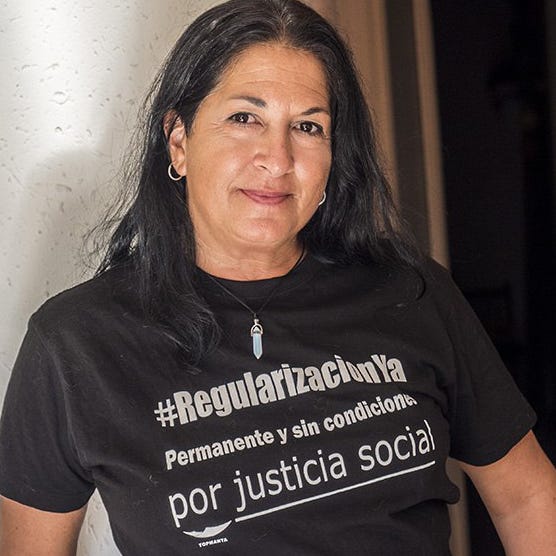
While Columba is usually treated by Spanish media as the main voice of the Regularisation movement, the group itself has four official spokespeople; three are feminist women, one is a male Senegalese immigrant.
The latter, Lamine Sarr, entered Spain illegally and spent years as a ‘manteros’ or street vendor. In a glowing New York Times profile of Sarr, it writes of how he and his friend were “deported and repeated the journey several times before eventually settling in the country permanently.”
But rather than being grateful to his new home, Sarr blames ‘the new colonialism’ perpetrated by Europeans for denying him prosperity in his native Africa:
The problem we have is that we live here because of capitalism and neo-colonialism that forces us to leave our country…If migration is growing every day, it is because of this. Because of this system that continues to impoverish Africa.
Sarr explicitly frames his lobbying for migrant rights as a way to give back to his fellow Africans, a small step to correcting the imbalance created by European domination.
Among the female spokespeople, Edith Espínola, a Paraguayan migrant, represented domestic and care workers, casting regularisation — the Spanish term for granting legal status to illegal migrants already in the country — as a fight against ‘structural racism,’ and ending a regime that ‘breaks and exploits women’s bodies.’ Silvana Cabrera, a Colombian hospitality worker, described the policy as an act of “an exercise in recognition, colonial reparation, and memory.” Kenia García, a Paraguayan immigrant and part of the ‘Seville Prostitutes Collective,’ represents migrant sex workers in the movement, decrying “the unjust class conditions” of her fellow prostitutes in Spain.
Street pressure alone, however, did not make law. That role fell to female-led leftist parties inside government, especially Sumar and Podemos, whose leverage over the governing Socialists turned regularisation into a coalition priority.
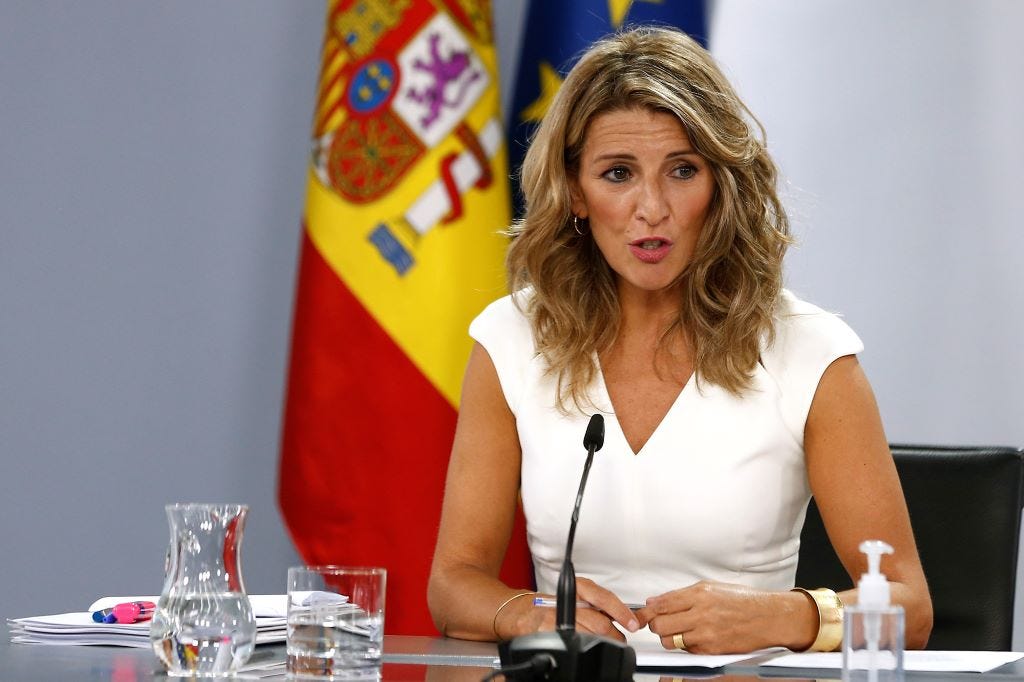
Chief among these women was Yolanda Díaz, leader of the progressive alliance Sumar and Spain’s Labour Minister. A former trade-union lawyer, Díaz reframed regularisation as a labour-market and demographic necessity to make it more palatable to Spaniards, arguing that the Spanish economy is dependent on migrant labour and could no longer function on informal employment agreements. Her female colleague Verónica Martínez Barbero handled the parliamentary mechanics, steering the citizen initiative through committees and preparing it for executive action.
Podemos, the far-left party that entered government as a junior coalition partner to PSOE in 2020, exerted the most pressure in parliament on regularisation. Here again, two women — Ione Belarra and Irene Montero — played the key role. Belarra, a former social worker and the party’s secretary-general, was the formal leader of Podemos during the regularisation push. Montero, who had just left office as Minister for Equality, became one of the most high-profile amplifiers for the campaign.
Together, they made regularisation a key plank of maintaining Podemos’s parliamentary leverage. Spain’s socialist coalition depends on a narrow majority, and the radical pro-migrant voices in government tied support for unrelated legislation to movement on regularisation.
At the far end of this political chain sat Elma Saiz, the ruling socialist party’s Minister for Inclusion, Social Security and Migration. Though the most radical lobbying came from the minority partners in government, Saiz was a radical member of her party on migration, in alignment with the demands of the minority coalition partners. In 2024, she had already overseen a first, more limited regularisation through reforms the expanded pathways to work permits and residency. That would become the precursor to this more recent and much more radical legalisation push, where her ministry took the radical step of approving an extraordinary regularisation by decree to regularise as many as a million illegal migrants.

Spain’s regularisation push lands in a country that already offers one of the most liberal citizenship regimes in Europe. Migrants from Latin America, as well as countries such as the Philippines, can apply for Spanish citizenship after just two years of legal residence. In practice, this means that extraordinary regularisation is not only about temporary legal status, but will now fast track hundreds of thousands of migrants into full citizenship on a timeline far shorter than in most EU states. And this comes at a time when most of Europe is tightening laws like this — countries like Italy have recently moved to tighten rules around ancestry-based “right of return” and limit access to citizenship for South Americans of European descent.
The role of the Church
It’s not really surprising to find a push to reward illegal migrants led by intersectional feminists, labour lawyers and immigrant activists. The tragic element of this story is that the primary backer of this anti-Spanish movement in civil society — the group that most normalised these radical demands to more moderate Spaniards — was the Catholic Church.
The regularisation movement boasted of having 900 NGOs behind it, but chief among them was Caritas, an organisation designed to be the social service and advocacy arm of the Catholic Church in Spain. Caritas is the organisation that speaks for the movement on the EU Commission website, and is often listed as one of the key early backers of the movement. Beyond public statements, Caritas and allied Church bodies used their nationwide network to document how ‘irregular status’ was denying migrants rights, and produced a number of policy proposals to make regularisation more palatable to politicians.
Though the Catholic Church often takes liberal stances on migration that have little downstream effect on policy, their role shouldn’t be underestimated here. The Church supplied parishes, charities, reports, and a moral authority that extended far beyond activist circles. The church provided a language of respectability and basic human dignity to the radical, intersectional and often explicitly anti-White framing of its activist founders.
Caritas was not an outlier in actually engaging in real activism on this issue. Alongside it, the Spanish Episcopal Conference, CONFER, the Jesuit-run Servicio Jesuita a Migrantes, and the Catholic NGO network REDES issued joint statements, research papers, and parliamentary appeals that embedded the regularisation campaign inside the Church’s broader social-justice infrastructure.

The Spanish Episcopal Conference — the national body that represents and coordinates Spain’s Catholic bishops — went beyond general appeals to compassion and actually explicitly endorsed extraordinary regularisation, bypassing parliament, as a national urgency. In a joint statement with Church migration and development bodies, the bishops’ conference described the policy as “an act of social justice and a recognition”
The story behind Spain’s regularisation push shows the many faces of the civil society coalition promoting European ethnic erasure. Long-established activist networks and NGOs, leftist political blocs, and migrant coalitions combining to pressure for replacement politics against a largely passive Spanish population — with one institution that should be a holdout of Spain’s historical identity instead aligning itself with this emergent coalition.
What you say is true, but I’ll provide more details. The right wing (PP and VOX) is promoting an invasion from Latin America. Both are subservient to Zionism and are competing for migrant votes. Africa is an issue, but the biggest problem is the Americas (immigration arriving by air). The separatists have also supported the invasion.
As a southerner that was constantly blasted by libshit exchange students from Spain (& other parts of Europe as well), that always looked down on us as toothless hillbillies… I’d like to talk to them now… that their countries are unrecognizable.
Not really. Their libshit ideals opened the door to this. I hate it for them on one hand… on the other hand FUCK EM!