
Why Sinn Féin Abandoned Nationalism
Reflections On Belfast, nationalism and Irish street politics

On Monday night, footage spread of a Sudanese migrant butchering a man on a street of Belfast, in what appeared to be an attempted decapitation. Since then, we have learned the victim, who has mental health and learning disabilities, suffered life-changing injuries, including losing one of his eyes.
This has led to an upswell of organic unrest from people in the North over immigration. There was widespread rioting and clashes with police, mostly in Protestant estates in Belfast, though there were smaller protests reported elsewhere across the province.
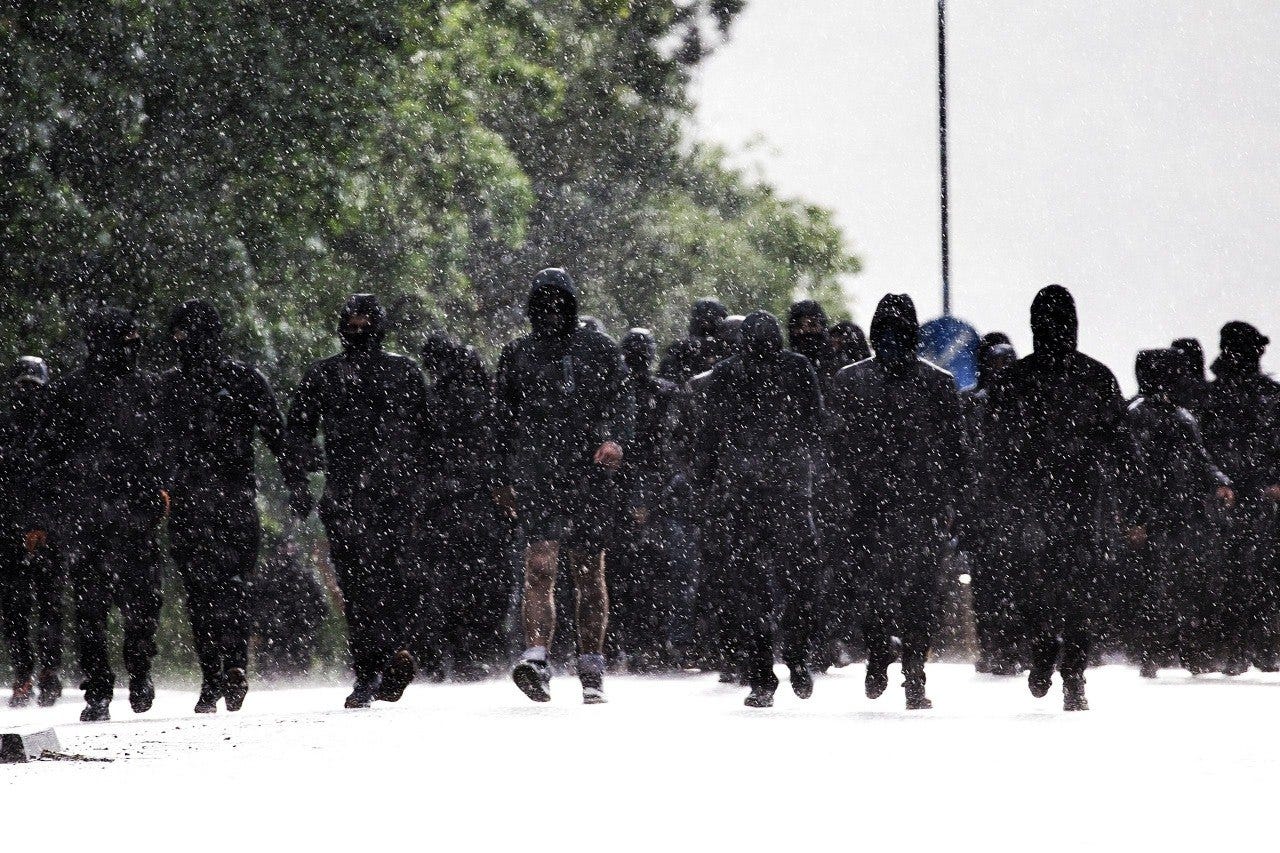
Although the attack happened in a Catholic area of Belfast, the victim was saved by a hurl-wielding Irishman named Maitiu, and these riots are being celebrated as an Irish uprising by foreign audiences, they are a largely loyalist affair.
Although much talk was made of a “uniting of the clans”, there was little if any evidence to suggest that Catholics or nationalists participated in the rioting in any large scale neither did the two communities engage in their usual sectarian clashes. The rioting was exclusively a Protestant, loyalist affair executed with the probable blessing of the main loyalist paramilitaries in the city, the Ulster Defence Association and the Ulster Volunteer Force.
It was the third race riot in as many years in the North, and this particular riot was exactly one year to the day following the beginning of race riots in the town of Ballymena, County Antrim when two Roma teenagers were arrested and initially charged with attempted rape of a young teenage girl. The charges were later dropped but of the substantial Roma population in the town pre-riots, two-thirds fled. Emboldened by that success, loyalist paramilitaries used the opportunity to expel migrants they fear to be potentially troublesome from their strongholds.
What explains the disparity? If you use X you may well encounter a group of Anglo-American influencers who never miss an opportunity to attack the leftist Irish and argue their national struggle is inextricably connected to a path of erasure through open borders.
In reality, opposition to immigration is one of the few issues that straddles old sectarian divides in Northern Ireland — Catholics and Protestants support and oppose immigration in almost equal numbers.
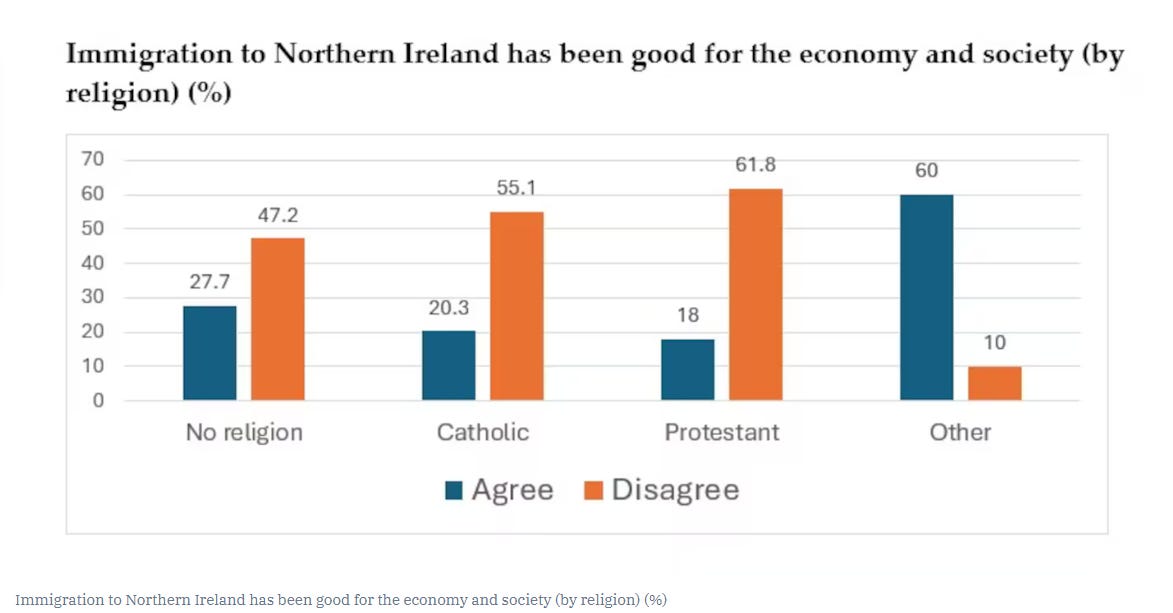
Europa Media has interviewed Irish nationalists on the ground in Belfast in recent days, and they sound nothing like their political leadership on immigration:

What is striking about Belfast was not that loyalists rioted, but that nationalists mostly did not — despite many ordinary Catholics privately sharing the same anxieties about immigration. That asymmetry reveals something important about the post-Good-Friday-Agreement order: loyalism retained a street-level political ecology, while republicanism was successfully absorbed into Sinn Féin’s electoral machine.
Reporting first-hand on the riots, Aris Roussinos described working-class Catholics watching their Protestant neighbours riot “with an anthropological detachment newly devoid of contempt.” While the orange and green may not be joining hands on this issue, this is clearly an issue where Sinn Féin’s leadership is totally at odds with its traditional base. Put simply, loyalists rioted and Irish nationalists didn’t because the latter are neutered by their political leadership.
Put less provocatively, unionist and loyalist working-class communities still possess a semi-autonomous political ecology beneath and around their formal parties. The DUP and UUP — the official parties of the unionist community — may condemn unrest, but they do not fully control the streets. Loyalist areas retain a network of paramilitary influence, community groups and informal authority structures that can mobilise collective action outside the grammar of respectable politics.
“Whatever happened to Sinn Féin?”
Nationalist areas once had something similar. Long before Sinn Féin became a serious electoral force, the republican movement had built a dense parallel society in nationalist areas, with its own networks of informal authority. The difference is that this world was gradually absorbed into Sinn Féin’s peace-process strategy. Whatever one thinks of Gerry Adams and Martin McGuinness, I’ve long considered them among the most formidable politicians Ireland has ever produced. If you understand the history of the island, it’s hard to overstate the political achievement of subordinating Republicanism’s militant, decentralised social movement entirely into a professionalised electoral machine, with only a handful of marginal dissenting groups breaking off in the process.
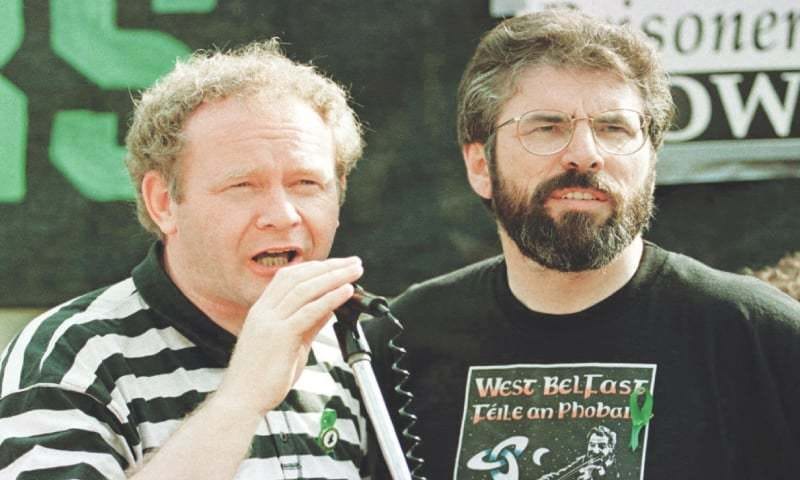
But there was an obvious cost to the subordination of republican street politics. The same party that was elected as the voice of nationalists in the North after the Good Friday Agreement now mostly constrains the political expression of its traditional base. Local grievance is filtered through the needs of a party that first sought international recognition in the language of liberal human rights universalism, and now seeks power on both sides of the border by courting middle-class progressivism.
Which takes me to a question I’ve probably been asked 100 times by non-Irish people since I became a public figure: “how did Sinn Féin become globalists?”


There are quite a few reasons for this.
The first was the peace process itself. In hindsight, Ruairí Ó Brádaigh and other traditional republicans who split from the Adams/McGuinness leadership were vindicated on their main argument: once Sinn Féin entered the electoral process, the process would change Sinn Féin more than Sinn Féin changed the process. Ó Brádaigh had led the traditionalist split in 1986, after Sinn Féin voted to abandon abstentionism toward Leinster House, arguing that participation in constitutional politics would inevitably moderate the movement. They were wrong about the viability of dissident republicanism, but not about the direction Sinn Féin would travel under Adams. The party could not pursue negotiations, office and international legitimacy while preserving the language and posture of revolutionary republicanism.
Did British Intelligence Infiltrate Sinn Féin?

In my opinion, there is no question that Martin McGuinness and Gerry Adams will be remembered as two of the most consequential figures in Irish history. The double act were part of a group of young nationalist radicals who emerged at the beginning of the Troubles to lead the Provisional IRA, but history will remember them most for their political work, …
Sinn Féin’s central problem on turning to politics from the late 1980s onward was not simply how to win votes, but how to bring the representatives of what was considered a terrorist movement into serious peace negotiations and government.
But this leftward shift did not begin with the peace process. It had roots in the political atmosphere out of which the Adams generation emerged. In the late 1960s and early 1970s, the language of civil rights was transforming political conflicts across the West, and in Belfast it offered younger republicans a way to present their grievance on the international stage not only as an Irish national question, but as a broader struggle against discrimination, sectarian policing and minority exclusion.
The great irony here is that much of the radicalism that helped transform Irish republicanism came not from the old republican tradition itself, but from a British university in Belfast, where the politics of the global New Left had taken hold among students.
Queen’s University Belfast was the home of People’s Democracy, a small socialist student movement that emerged in the late 1960s. From there it overlapped into republican circles by becoming a major voice for the civil rights struggle and street activism on behalf of Catholics in the North.
A useful account of this shift appears in Sinn Féin and the Politics of Left Republicanism, a study of how republican politics moved leftward in the decades before and during the peace process. Its author, Eoin Ó Broin, quotes Jim Gibney — a former IRA volunteer and later Sinn Féin figure — describing People’s Democracy as having “dominated the scene politically” in Belfast in the early 1970s. Ó Broin draws out the significance of that admission:
When former IRA volunteer and senior Sinn Féin member Jim Gibney retrospectively described the left-wing political grouping, People’s Democracy, as ‘dominating the scene politically from 1970 to about 1975’ and as ‘the political leadership of what we loosely called the anti-imperialist movement’ in Belfast, he was admitting not the absence of a distinct Sinn Féin message or programme of activity, but rather at best the absence and at worst the irrelevance of that message from the centres of conflict in the North. Gibney’s comments also highlight a political gap, between the 1960s’ generation of Ó Brádaigh, Ó Conaill and MacStiofáin and the younger generation of republicans emerging from within the civil rights movement, of which Gibney was one. Christian socialism, federalism and the building of alternative state institutions had less purchase for those seeking to play an active part in the activity of the IRA, or for those more attuned to the radical political message of People’s Democracy.1
This point is important. Both old supporters and opponents of Sinn Féin have often assumed that its egalitarian language was merely a façade for a harder nationalist agenda.
But for the mostly working-class young men who comprised the Adams generation, civil-rights radicalism had already changed the way the struggle was understood. Republicanism did not cease to be nationalist, but nationalism increasingly passed through the moral vocabulary of the late-1960s left: oppressed minorities against oppressive states, colonised peoples against empire, communities against systems of exclusion. While many volunteers surely understood this as little more than a useful framing to legitimise their armed struggle, over time it became the party’s moral universe.
Secondly, Sinn Féin’s electoral strategy required becoming a governing party both in the North and the South. In the 26 counties, old-style northern republicanism had a hard ceiling. In the 1990s, Sinn Féin was largely despised by “middle Ireland” for its association with sectarianism and violence, especially for IRA actions which killed Irish army members and Gardaí. Its path to growth lay among younger, more radical voters disillusioned with the old centre of Fianna Fáil and Fine Gael. This mattered because the available opposition vote in the South was generally to the left of the parties in government. Fianna Fáil and Fine Gael occupied the broad centre, leaving Sinn Féin to expand among voters who saw the old order as economically conservative, socially stale and morally exhausted.
This pulled Sinn Féin toward the moral vocabulary of the southern progressive class, where housing, welfare, feminism, LGBT politics and anti-racism all formed part of a wider language of liberal respectability. The more successful Sinn Féin became in the South, the more it had to satisfy voters whose instincts were very different from those of its traditional northern base.
This shift also had a class dimension. The more Sinn Féin became a serious electoral party, the more it attracted and promoted the kind of people who could operate in the world of media, NGOs, policy forums and government departments. That did not mean abandoning the old base symbolically; if anything, the memory of working-class republicanism remained central to the party’s moral identity. But the party’s practical incentives increasingly pointed toward a different constituency that was culturally progressive and spoke the language of modern leftism.
As this shift has happened, so has Sinn Féin’s drift into a third-worldist framing of the Irish struggle. Part of this was strategic: once Britain was integrated into NATO and the old European anti-British alignments had disappeared, the IRA increasingly looked to the revolutionary Third World for allies, receiving arms from Libya and cultivating solidarity with movements like the PLO and ETA. But in the modern left-wing imagination, where White guilt is the dominant moral category, this has taken on a new symbolic importance. By recasting Ireland as one oppressed people among many in a global anti-colonial coalition, Irish leftists can celebrate their own rebel tradition while translating it into the fashionable idiom of Palestine, Black civil rights and “decolonisation" in the abstract.

Republicanism and the ethnic question
But the deepest reason for Sinn Féin’s post-Good-Friday-Agreement trajectory is ideological.
Human rights universalism offered Sinn Féin a way to avoid the most difficult question in Irish republicanism: the ethnic basis of the conflict itself. Republicanism under Adams/McGuinness has tried to present the struggle as an anti-colonial and civil rights conflict, denying any framing of the conflict as fundamentally a contest between two historic peoples on the same territory. The problem, in this telling, was not that two distinct peoples were contesting the same country, one descended largely from historical settlers and the other from the native Irish. It was that a minority — “Catholics,” a proxy for the ethnic Irish as distinct from unionists — had been denied equality by a colonial administration imposed from outside. This framing allowed Adams and co. to sidestep the most difficult moral challenge to the republican struggle: that in pursuing Irish unity through force, they were to some degree denying the self-determination demands of the nationally distinct Ulster-Scots population living on the island.
Republicanism as framed by Adams rests on a moral claim that Ireland was one nation artificially partitioned by Britain, and that unionism was ultimately a political distortion sustained by colonial power, a kind of false consciousness certain Irish Protestants have adopted. To recognise unionists as a people in their own right would complicate the republican case. It would mean admitting that Irish unity was not simply the completion of national democracy, but the absorption of one historic community into a state defined by another.
This tension is clear in Gerry Adams’ own writing. In his book Free Ireland, Adams writes that “The Loyalists have a desperate identity crisis. They agonise over whether they are Ulster-Scotch, Picts, English or British.” Elsewhere he claims: “There are no cultural or national links between the Loyalists and the British, no matter how much the Loyalists scream about their ‘British way of life’.”2
These lines are revealing. Adams is not merely attacking unionist politics. He is denying them the status of a coherent people. He says there are no evident national links to Britain, but of course there is in one very important sense — their heritage. This means that Adams was not denying unionist identity specifically so much as he was effectively denying the political relevance of ethnic and ancestral categories altogether.
It does not take a great imagination to see how this framing of the conflict would superimpose on the politics of immigration and national identity elsewhere. If Irishness is open, plural, anti-essentialist and detached from ancestry, then immigration becomes difficult to oppose in nationalist terms. If the conflict in the North was never really about competing peoples, but only about rights and equality, then the party’s natural destination is a politics in which all group particularity is dissolved into liberal inclusion.
Coming back to the present day, though the sentiment is there, the prospects for a new Irish nationalist movement in the North organising outside Sinn Féin are extremely bleak. The old republican ecosystem has been so successfully monopolised by the party that any attempt to organise independently would be treated as a threat to the movement’s internal sovereignty. It would not just face the usual denunciations as “far-right” that nationalists meet in the South, but would be branded anti-republican, sectarian, loyalist-adjacent or useful to the British state before it ever had the chance to build roots. It would also come up against older networks of control and intimidation that are largely invisible to outsiders precisely because Sinn Féin’s dominance extends far beyond ordinary electoral politics.
The events of the past week in Belfast show the consequences of that asymmetry. Immigration may now be one of the few issues on which ordinary Protestants and Catholics sound more alike than their political leaders, but sentiment alone does not create politics. Recent events demonstrate that loyalism still retains the networks and muscle memory of collective action. Irish republicanism has had them too. But those capacities continue to atrophy amid Sinn Féin’s long march into liberal respectability and governance.
Broin, Eoin Ó. Sinn Féin and the Politics of Left Republicanism. Pluto Books, 2009.
Adams, Gerry. Free Ireland: Towards a Lasting Peace. Dingle: Brandon, 1995.
I’m surprised the article didn’t bring up Westminster legalizing abortion in Northern Ireland a few years back. The DUP largely condemned the move as sidestepping Stormont and meddling in Northern Ireland’s internal affairs. Sinn Fein, on the other hand, applauded the move.
The irony of Nationalists applauding the British Parliament for legalizing the killing of unborn babies in Northern Ireland, violating Stormont’s authority and violating the spirit (if not the letter) of the Good Friday Agreement. Something utterly unthinkable just a generation ago.
Thank you for the explanation. As someone of Irish Catholic heritage, I find this a source of profound collective shame